HexClad vs All-Clad: Which Cookware Is Better for You?
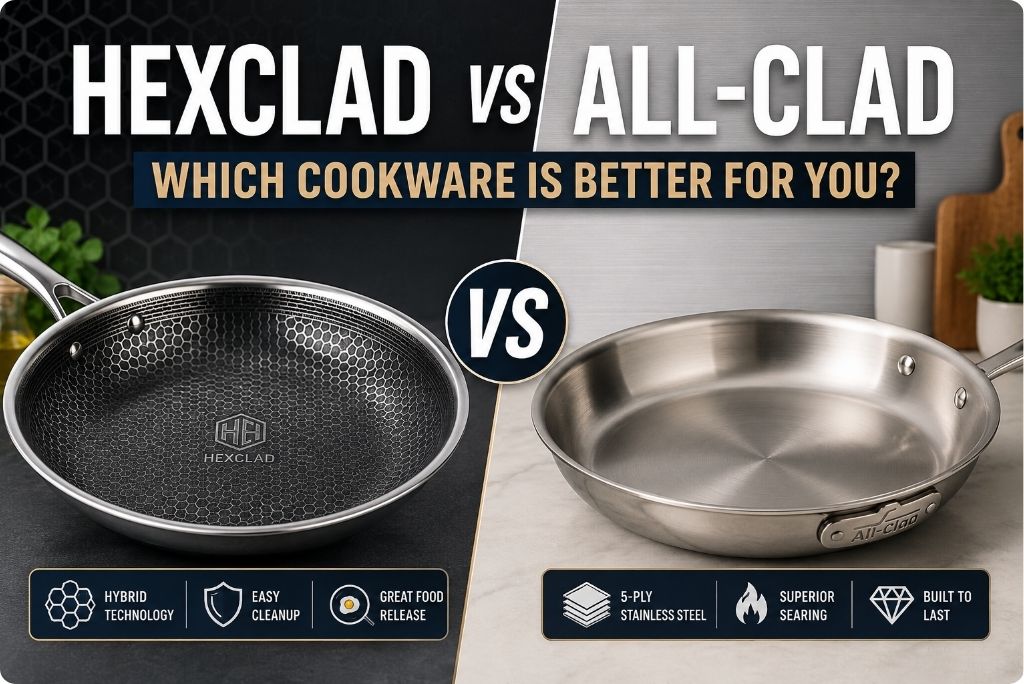
Choosing between HexClad and All-Clad can be difficult because the two cookware brands approach cooking in different ways. HexClad is known for its hybrid cookware design, which combines the convenience of nonstick cookware with the feel of stainless steel. Meanwhile, All-Clad is best known for its traditional multi-layer stainless-steel cookware, which is designed for strong heat control, searing, browning, and long-term durability.
So, which is better?
The honest answer is that HexClad vs All-Clad is less about choosing the universally “best” brand and more about choosing the cookware that matches the way you cook. If you want an easier food release and a more forgiving everyday cooking experience, HexClad may be more appealing. If you enjoy searing, browning, making pan sauces, and cooking with traditional stainless steel, All-Clad may be the better fit.
In this comparison, we’ll look at the differences that actually matter in a real kitchen, including cooking performance, food release, cleaning, durability, compatibility, value, and the types of foods each cookware style handles best.
HexClad vs All-Clad at a Glance
| Category | HexClad | All-Clad |
| Core approach | Hybrid cookware | Traditional stainless steel |
| Cooking surface | Hybrid stainless/nonstick design | Stainless steel |
| Food release | Generally easier for everyday foods | Requires more technique |
| Searing | Very good | Excellent |
| Browning and fond | Good | Excellent |
| Delicate foods | More forgiving | Requires careful temperature control |
| Cleanup | Generally easier | Can require more effort |
| Durability | Good, with proper surface care | Excellent stainless-steel durability |
| Learning curve | Lower | Higher |
| Best for | Convenience-focused home cooks | Cooks who enjoy traditional stainless steel |
| Best overall value | Depends on priorities | Depends on priorities |
Quick verdict: Choose HexClad if your priority is convenience, easier food release, and a more forgiving everyday cooking experience. Choose All-Clad if you want traditional stainless-steel performance, excellent browning, strong searing, and cookware that rewards good cooking technique.
There’s also a third option that many comparisons overlook: you don’t necessarily have to choose one brand for everything. A combination of cookware types can sometimes make more sense than expecting one pan to handle every cooking task equally well.
What Is the Difference Between HexClad and All-Clad?
The biggest difference comes down to the cooking surface and the overall cooking experience.
HexClad uses a hybrid design that combines stainless steel with a nonstick-oriented surface. The raised stainless-steel pattern is designed to provide durability and help protect the cooking surface while allowing the pan to offer easier food release than traditional stainless steel.
All-Clad’s traditional stainless-steel cookware takes a different approach. Its multi-layer construction uses bonded layers designed to improve heat distribution and cooking performance. The cooking surface itself is stainless steel rather than a nonstick coating.
That difference affects almost everything you do with the pan.
HexClad’s Hybrid Cookware Design
The main appeal of HexClad is its attempt to bridge the gap between two common cookware choices.
Traditional nonstick cookware is convenient for foods such as eggs and fish, but many home cooks eventually look for cookware with a more durable construction and stronger high-heat cooking ability. Traditional stainless steel, on the other hand, can be excellent for searing and browning but has a steeper learning curve.

HexClad’s hybrid approach aims to give home cooks some of the convenience of nonstick cooking while retaining a stainless-steel cooking surface pattern.
The important thing to understand is that hybrid cookware should not automatically be treated as identical to either traditional nonstick or bare stainless steel. It is its own category with its own strengths and limitations.
It can make everyday cooking easier, but you should still follow the manufacturer’s instructions for heat, utensils, cleaning, and care.
All-Clad’s Multi-Layer Stainless-Steel Construction
All-Clad’s traditional stainless-steel cookware is built around bonded layers of metal. The goal is to combine the cooking characteristics of different metals, such as stainless steel and heat-conductive aluminum, in a single piece of cookware.
In simple terms, the stainless steel provides the cooking surface and durability, while the conductive layers help spread heat more effectively.

This design is particularly useful for cooks who want precise control over temperature and strong performance when searing, browning, sautéing, and making sauces.
The trade-off is that stainless steel requires more technique. If you put cold food into a pan that is too hot—or use the wrong heat level—you may experience sticking. With proper preheating, temperature control, and enough cooking fat, stainless steel can be much easier to use than beginners often expect.
Why the Difference Matters When You Cook
The construction difference becomes most obvious when you cook different types of food.
With HexClad, the focus is more on convenience and easier food release. With All-Clad stainless steel, the focus is more on control, browning, searing, and traditional cooking techniques.
Neither approach is automatically better.
A person who cooks eggs every morning may value the forgiving nature of hybrid cookware more than the ability to build a deep fond for a pan sauce. A home cook who regularly sears steaks and deglazes the pan may prefer the control and browning potential of stainless steel.
That is why the best comparison isn’t simply “Which brand wins?” The more useful question is
Which cooking experience fits your kitchen and your habits?
HexClad vs All-Clad: Cooking Performance Compared
The most important part of any cookware comparison is what happens when you actually use the pan.
Price, appearance, and brand reputation matter, but the cookware still has to perform well on the stove. The differences between HexClad and All-Clad become much clearer when you look at specific cooking tasks.
Heat Distribution and Heat Responsiveness
Good cookware should distribute heat evenly and respond predictably when you change the burner setting.
All-Clad’s bonded multi-layer construction is designed to provide consistent heat distribution while retaining the responsiveness needed for controlled cooking. This is particularly useful when you’re moving between medium and high heat or adjusting the temperature during a recipe.
HexClad can also perform well for everyday cooking, but its main advantage isn’t necessarily that it gives experienced cooks a fundamentally better stainless-steel cooking experience. Its appeal is the balance between performance and convenience.
For most home cooks, the practical difference is this:
All-Clad rewards you for learning how to control the pan. HexClad is designed to make everyday cooking more forgiving.
That doesn’t mean one has poor heat control. It means the two products emphasize different priorities.
Searing and Browning
If you frequently cook steak, chicken, pork, or other proteins, searing performance matters.
Traditional stainless steel has a major advantage for cooks who enjoy developing a strong browned crust and creating fond—the flavorful browned bits left in the bottom of the pan. Once you add liquid and deglaze the pan, that fond can become the foundation of a sauce.
This is one of the areas where All-Clad’s stainless-steel cooking surface is especially attractive.
HexClad can certainly sear meat, and many home cooks will get very good results. However, if your cooking style revolves around high-heat searing followed by deglazing and sauce-making, traditional stainless steel is often the more natural choice.
A useful example is cooking a steak.
With All-Clad, you can heat the pan, add oil, sear the steak, and build browned bits that can later be used for a pan sauce. The process is very much part of traditional stainless-steel cooking.
With HexClad, you can still sear, but the main reason to choose it is usually not that it offers a better fond-building experience than stainless steel. Its strength is the broader balance between searing ability and everyday convenience.
Best for serious searing and pan-sauce cooking: All-Clad.
Food Release and Delicate Foods
This is where HexClad becomes particularly attractive.
Eggs, fish, pancakes, and other delicate foods can be frustrating in stainless steel if the temperature, preheating, or oil level isn’t right.
A well-used stainless-steel pan can handle these foods, but it takes practice. You need to understand when the pan is ready, how much oil to use, and when food is naturally ready to release.
HexClad offers a more forgiving experience for many everyday foods.
However, it is important not to confuse “easier food release” with “completely maintenance-free nonstick performance.” Hybrid cookware still requires appropriate heat management and care.
If you regularly cook delicate foods and want to reduce the learning curve, HexClad may be the more convenient choice.
Best for easier everyday food release: HexClad.
Everyday Cooking and Versatility
Both types of cookware can handle a wide range of everyday tasks.
You can sauté vegetables, cook proteins, prepare one-pan meals, and handle many common recipes with either option.
The difference is how much attention you need to give to the cooking process.
For example, if you’re making a quick dinner after work, you may appreciate cookware that makes cleanup and food release easier. In that situation, HexClad’s convenience can be valuable.
If you’re cooking slowly and intentionally, carefully building flavor through browning and deglazing, All-Clad’s stainless-steel characteristics may be more appealing.
This is why “versatility” needs to be judged carefully. Both are versatile, but they are versatile in different ways.
HexClad vs All-Clad: Cleaning, Maintenance, and Durability
The best cookware isn’t only the pan that performs well on the stove. It is also the pan you’re happy to use repeatedly.
Cleaning and maintenance can have a major effect on whether cookware remains enjoyable over many years.
Which Is Easier to Clean?
For many home cooks, HexClad will be the easier option for everyday cleanup because its hybrid surface is designed to make food release more convenient.
That can be especially useful when cooking eggs, sticky foods, or meals that might otherwise leave residue behind.
All-Clad stainless steel can require more effort when food sticks or when the pan develops discoloration. However, stainless steel has an important advantage: it doesn’t have a nonstick-style cooking surface that you need to protect in the same way.
With proper cleaning methods, stainless steel can be restored after many common cooking mishaps.
The key difference is simple:
HexClad may make routine cleanup easier, while All-Clad stainless steel can be more forgiving over the very long term when it comes to the cooking surface itself.
Always follow the specific care instructions provided with your cookware, since recommendations can vary between product lines.
Which Requires More Maintenance?
HexClad requires you to pay attention to the care of its hybrid cooking surface. Proper cleaning, appropriate utensils, and reasonable heat all matter.
All-Clad requires more attention during cooking. You need to manage temperature and preheating properly to reduce sticking and get the best results.
So the maintenance burden is different.
With HexClad, you may spend less effort managing food release, but you still need to take care of the cooking surface.
With All-Clad, you may spend more effort learning how to cook with stainless steel, but the stainless-steel cooking surface itself is highly durable.
This creates an important distinction:
HexClad may have a lower cooking learning curve, while All-Clad may have a lower dependence on a specialized cooking surface over the long term.
Which Is More Durable?
Durability should be considered from two angles: the body of the cookware and the cooking surface.
Traditional stainless steel has a strong reputation for long-term durability because the cooking surface itself is stainless steel. It can tolerate many years of regular cooking when properly maintained.
Hybrid cookware also has a durable construction, but the cooking surface introduces different care considerations. How you use and maintain the pan can affect its long-term performance.
That doesn’t mean HexClad is fragile. It means you should not evaluate the two products using exactly the same definition of durability.
If your priority is a cookware surface designed for long-term stainless-steel use, All-Clad has a clear appeal.
If your priority is combining convenience with a durable hybrid design, HexClad may make more sense.
HexClad vs All-Clad: Compatibility and Practical Use
Before buying expensive cookware, make sure it works with your kitchen.
Induction and Other Cooktops
Both brands offer cookware designed for different types of cooktops, but compatibility can vary by specific product line.
Before purchasing, check the exact model you’re considering for compatibility with:
- Induction
- Gas
- Electric
- Glass-top cooktops
This is particularly important with induction because cookware must have a compatible magnetic base.
Don’t assume that every piece from a brand has identical compatibility. Always verify the manufacturer’s specifications for the exact product.
Oven Use
Both HexClad and All-Clad offer cookware suitable for oven use, but maximum temperatures can vary depending on the specific cookware and components.
Handles, lids, and other materials may have different temperature limits.
If you regularly move cookware from the stovetop into the oven, check the exact manufacturer’s instructions before buying.
Cooking Acidic Foods
Foods containing tomatoes, wine, vinegar, or citrus are common in many kitchens.
Traditional stainless steel is widely used for acidic cooking, which is one reason it remains popular with cooks who frequently prepare sauces, braises, and reductions.
For hybrid cookware, follow the manufacturer’s specific guidance on cooking acidic ingredients and cleaning afterward.
The important point is not to rely on broad assumptions about an entire brand. Always check the care and use instructions for the specific cookware you’re buying.
HexClad vs All-Clad for Different Cooking Tasks
The best way to choose between these cookware types is to think about what you actually cook.
Best for Eggs and Delicate Foods
HexClad has the advantage of convenience.
If you frequently cook fried eggs, omelets, fish, or other foods that tend to stick, a hybrid surface can make the process easier and more forgiving.
All-Clad stainless steel can also cook these foods successfully, but you’ll need better control of heat, preheating, and cooking fat.
If you’re new to stainless steel, this difference can be significant.
Best for Steak and High-Heat Searing
All-Clad is the stronger choice for cooks who prioritize traditional searing and browning.
Its stainless-steel cooking surface is well suited to developing fond and building the foundation for pan sauces.
HexClad can still sear meat effectively, but its biggest advantage is not necessarily superior performance in traditional stainless-steel searing techniques.
If steak night often involves a pan sauce made from the browned bits left behind, All-Clad is likely the better match.
Best for Fish
HexClad is generally the more forgiving option for delicate fish.
Fish can be difficult because they can break apart or stick when you try to turn them.
A cookware surface that provides easier food release can reduce some of that frustration.
That said, temperature still matters. Even cookware designed for easier food release can produce poor results if it is overheated or used incorrectly.
Best for Pan Sauces and Deglazing
All-Clad has the edge.
Traditional stainless steel is particularly well suited to developing fondants and then deglazing the pan with stock, wine, or another liquid.
This is one of the clearest reasons an experienced home cook may prefer stainless steel even if hybrid cookware is easier for other tasks.
If you enjoy cooking restaurant-style pan sauces at home, stainless steel is difficult to beat.
Best for Everyday Cooking
This one is more personal.
For busy home cooks who want convenience, easier cleanup, and simpler food release, HexClad may be the better everyday option.
For cooks who enjoy the process of controlling heat, developing browning, and building sauces, All-Clad may be more rewarding.
Both can handle everyday meals. The difference is in which cooking experience you prefer.
HexClad vs All-Clad: Which Is Better for Your Cooking Style?
Rather than asking which brand is objectively better, start by asking what you want from your cookware.
Choose HexClad If You:
- Want easier food release for everyday cooking.
- Frequently prepare eggs or delicate foods.
- Prefer a more forgiving cooking experience.
- Want convenient cleanup.
- Don’t want to spend as much time learning stainless-steel cooking techniques.
HexClad makes particular sense for people who value convenience without moving entirely toward traditional nonstick cookware.
Choose All-Clad If You:
- Enjoy traditional stainless-steel cookware.
- Frequently sear and brown meat.
- Make pan sauces and reductions.
- Want a durable stainless-steel cooking surface.
- Enjoy learning and improving your cooking technique.
All-Clad is especially appealing to cooks who see the cookware itself as part of the cooking process rather than simply a tool for getting food onto the plate.
Consider a combination if:
You don’t have to make your entire kitchen one brand.
In fact, a mixed cookware setup may be the most practical solution for some home cooks.
For example, you might use a hybrid pan for eggs and delicate foods while keeping a stainless-steel skillet for steak, browning, and pan sauces.
This approach recognizes something that many brand comparisons miss:
Different cooking tasks benefit from different cookware characteristics.
If you cook a wide variety of foods, choosing cookware based on the job may give you more flexibility than choosing a single brand for every task.
HexClad vs All-Clad: Which Offers Better Value?
Value isn’t simply about which cookware costs less.
A better question is
Will this cookware perform the jobs I need, last long enough, and be enjoyable enough to use regularly?
Consider More Than the Purchase Price
When comparing the value of HexClad and All-Clad, consider:
- Initial purchase price
- How frequently will you use the cookware
- Expected longevity
- Ease of cleaning
- Maintenance requirements
- Cooking performance
- Whether you’ll need additional cookware later
A cheaper pan that you dislike using may provide less real value than a more expensive pan that becomes your everyday favorite.
Likewise, paying a premium for features you don’t actually need isn’t necessarily good value.
Should You Buy a Full Cookware Set?
Not necessarily.
A large cookware set can look attractive, but many households end up using the same two or three pieces repeatedly.
Before buying a set, think about the cookware you actually use most often.
For example, if you mainly cook for two people, you may get more value from purchasing a few carefully chosen pans than from buying a large collection with pieces that rarely leave the cabinet.
Buying individual pieces can also let you choose cookware based on the cooking task.
You might decide that one hybrid skillet and one stainless-steel skillet cover most of your needs.
Best Value for Different Buyers
For convenience-focused cooks, HexClad may offer better practical value if easier food release and cleanup are priorities.
For serious home cooks: All-Clad may offer stronger value if you frequently sear, brown, deglaze, and cook with stainless steel.
For beginners: HexClad may be easier to live with initially, while All-Clad can be a worthwhile investment if you’re willing to learn stainless-steel cooking techniques.
For long-term cookware buyers: All-Clad’s traditional stainless-steel construction has strong appeal for people who want cookware without relying primarily on a nonstick-style cooking surface.
Read More: Viking vs All-Clad
HexClad vs All-Clad: Pros and Cons
HexClad Pros and Cons
Pros
- Easier food release for many everyday foods
- Convenient for eggs and delicate ingredients
- More forgiving for many home cooks
- Good balance of convenience and cooking performance
- Practical for everyday use
Cons
- Requires appropriate care of the hybrid cooking surface
- May not provide the same traditional stainless-steel experience for searing and pan sauces
- Premium pricing may not suit every budget
- Not necessarily the best choice if your main goal is traditional stainless-steel cooking
All-Clad Pros and Cons
Pros
- Excellent for searing and browning
- Well suited to fond development and pan sauces
- Durable stainless-steel cooking surface
- Rewards good cooking technique
- Strong long-term appeal
Cons
- Steeper learning curve
- Food can stick when temperature and technique are not managed properly
- Cleanup may require more effort
- Premium pricing
How We Compared HexClad and All-Clad
A fair cookware comparison should look beyond marketing claims and focus on the factors that affect real cooking.
The most useful comparison criteria include
- Construction and materials
- Heat distribution
- Heat responsiveness
- Searing and browning
- Food release
- Performance with delicate foods
- Cleaning
- Maintenance
- Durability
- Cooktop compatibility
- Oven use
- Overall value
When evaluating specific models, manufacturer specifications and care instructions should be checked carefully because features and temperature limits can vary between product lines.
It is also important to separate manufacturer claims from independent observations. For example, a brand can describe how a product is designed, but actual cooking performance should be evaluated through credible testing or clearly explained cooking principles.
If you’re conducting your own hands-on comparison, an even stronger test would involve cooking the same foods in comparable pan sizes and recording the results for eggs, steak, fish, vegetables, and cleanup. That provides a more useful picture of everyday performance than simply comparing marketing specifications.
Read More: HexClad vs Le Creuset Cookware
FAQs About HexClad vs All-Clad
Is HexClad better than All-Clad?
Neither is universally better. HexClad is generally the better fit for cooks who prioritize convenience and easier food release, while All-Clad is often better suited to cooks who prioritize traditional stainless-steel performance, searing, browning, and pan sauces.
Is All-Clad better for searing?
For traditional stainless-steel searing and browning, All-Clad has a strong advantage. Its stainless-steel cooking surface is particularly well suited to developing fond that can be used for pan sauces.
Which lasts longer?
All-Clad’s traditional stainless-steel cooking surface has a strong long-term durability advantage because it does not rely on a nonstick-style surface for food release. However, the lifespan of any cookware depends heavily on how it is used and maintained.
Is HexClad truly nonstick?
HexClad is a hybrid cookware design rather than conventional fully coated nonstick cookware. It is designed to provide easier food release while combining stainless-steel elements with its hybrid surface.
Which is better for induction?
Both brands offer induction-compatible cookware, but compatibility depends on the specific product. Always check the exact model before purchasing.
Final Verdict
The HexClad vs. All-Clad decision ultimately comes down to the type of cooking experience you want.
Choose HexClad for convenience. It is a strong option if you want easier food release, frequently cook delicate foods, and prefer a more forgiving everyday experience.
Choose All-Clad for traditional stainless-steel performance. It is the better match if you enjoy searing meat, developing deep browning, making pan sauces, and getting the most from stainless-steel cooking techniques.
Choose All-Clad for searing, browning, and pan sauces.
Choose HexClad for easier food release and everyday convenience.
Choose All-Clad if long-term stainless-steel ownership is your priority.
But there is no need to force yourself into an all-or-nothing decision. For many home cooks, the smartest solution may be to use different cookware for different jobs. A hybrid pan can make breakfast and delicate foods easier, while a quality stainless-steel skillet can handle steak, browning, and pan sauces.
In the end, the best cookware is the one that fits how you actually cook. If you value convenience and want a lower learning curve, HexClad may be the better choice. If you enjoy traditional cooking techniques and want durable stainless-steel performance, All-Clad may be the investment you’ll appreciate for years to come.