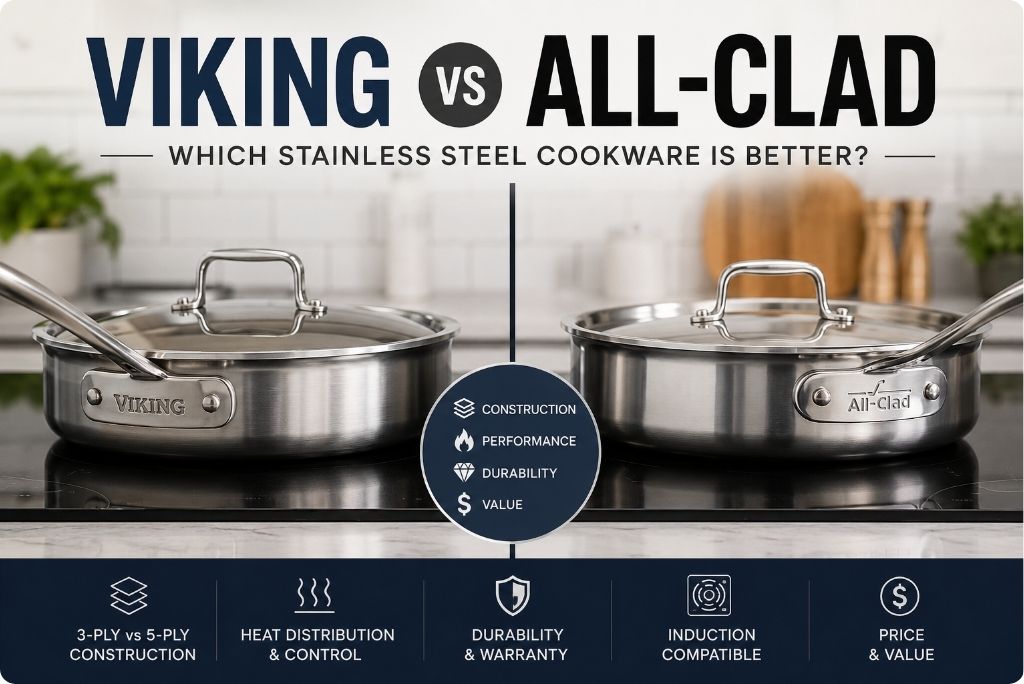
Viking vs All-Clad: Which Stainless Steel Cookware Is Better?
If you are comparing Viking vs All-Clad, you are probably not just shopping for a pan. You are trying to choose cookware that will heat evenly, feel comfortable in the hand, last for years, and justify a premium price. That is the right way to approach this comparison, because both brands sell stainless steel cookware built for serious home cooks, but their construction, feel, and value proposition are not identical.
Viking currently offers both 3-ply and 5-ply stainless steel collections, while All-Clad’s core stainless lines include D3 tri-ply and D5 five-ply cookware, both engineered for induction compatibility and oven use up to 600°F.
Quick Verdict
The short answer is this: Viking tends to appeal to cooks who want a heavier, more substantial pan with strong heat retention in its 5-ply line, while All-Clad is the classic pick for people who want responsive tri-ply cookware with a long track record and broad recognition. Both brands make excellent cookware, but the best choice depends on how you cook, how much weight you are comfortable lifting, and whether you value responsiveness or thermal mass more.
All-Clad describes D3 as its original fully bonded tri-ply cookware, and D5 as its five-ply collection built for even heating and warp resistance. Viking describes its 3-ply line as responsive everyday cookware and its 5-ply line as premium cookware designed for stronger heat control and durability.
Viking vs All-Clad at a Glance
| Category | Viking | All-Clad |
| Construction | 3-ply and 5-ply options | D3 tri-ply and D5 five-ply options |
| Heat behavior | Strong heat control, especially in 5-ply | Fast, even, responsive heating |
| Searing | Excellent in heavier collections | Excellent in D3 and D5 |
| Delicate cooking | Good, especially when preheated properly | Very good because of responsiveness |
| Induction | Supported on current stainless lines | Supported on D3 and D5 |
| Oven use | Up to 600°F on current stainless lines | Up to 600°F on current stainless lines |
| Weight and feel | Often feels substantial | Often feels a bit lighter in D3 |
| Cleaning | Stainless steel care required | Stainless steel care required, handwashing preferred |
| Durability | Limited lifetime warranty on most cookware | Limited lifetime warranty on cookware |
| Best for | Cooks who like heft and heat stability | Cooks who like responsiveness and a classic clad feel |
This snapshot reflects the current official product information for each brand’s stainless steel lines. Exact details can vary by collection, so it is always worth checking the specific pan or set before buying.
Which One Should You Buy?
Choose Viking if you like a pan that feels substantial, you often sear meats or cook at stable medium-high heat, and you are interested in the brand’s 5-ply construction for stronger thermal mass. Choose All-Clad if you want a proven tri-ply option, fast temperature response, and a cookware line that has become a benchmark for bonded stainless steel.
If you mainly want a lightweight nonstick pan or you cook only occasionally, neither premium stainless line may be the best value for you. All-Clad’s D3 is explicitly positioned as responsive tri-ply cookware, while D5 is designed for steadier heat and warp resistance; Viking makes a similar split between 3-ply everyday use and 5-ply performance-focused cookware.
What’s the Difference?
The biggest difference between Viking and All-Clad is not just branding. It is how each company approaches clad stainless steel cookware. All-Clad’s D3 line is the original fully bonded tri-ply collection, with stainless steel on the outside and an aluminum core for faster, even heating. Its D5 line adds extra layers and is marketed for exceptionally even heating and warp resistance.
Viking’s current stainless steel lines follow a similar logic: the 3-ply line is built for responsive everyday performance, while the 5-ply line adds more layers for stronger heat control and a heavier cooking feel.
Cookware Construction and Materials
In practical terms, stainless steel cookware works because the stainless exterior gives you durability and a cooking surface that holds up well over time, while the aluminum layer or core helps spread heat more evenly across the pan. That is why clad cookware usually performs better than thin stainless cookware. All-Clad states that D3 uses three bonded layers, and D5 uses five bonded layers. Viking similarly describes its 3-ply line as aluminum-core stainless cookware and its 5-ply line as alternating stainless steel and aluminum layers for stronger heat distribution and retention.
The important point is that more layers can help, but layers alone do not decide everything. Pan thickness, balance, handle shape, and how the heat spreads across the cooking surface all matter too. A well-made tri-ply pan can outperform a poorly designed five-ply pan, and a heavier pan is not automatically a better pan for every kitchen. That is why this comparison needs to focus on how the cookware behaves, not just how many layers the marketing material lists.
Viking vs All-Clad Product Lines
The most useful comparison is not “brand versus brand” in the abstract. It is collection versus collection. A Viking 3-ply pan is much more comparable to All-Clad D3 than to All-Clad D5. Likewise, Viking’s 5-ply cookware is a closer match to All-Clad D5. All-Clad’s own product pages make the D3/D5 distinction clear, and Viking’s cookware pages separate 3-ply and 5-ply collections for the same reason: the cooking experience is not the same.
That matters because a lot of cookware comparisons get sloppy. A reader may see “Viking vs All-Clad” and assume one brand is simply better in every case. In reality, the right question is usually: Which specific collection is a better fit for the way I cook? If you compare equivalent constructions, the answer becomes much more honest and much more useful.
Does More Ply Mean Better Cookware?
Not always. Five-ply cookware can feel more stable, hold heat better, and resist warping well, but it can also feel heavier and a little slower to change temperature. Tri-ply cookware usually responds more quickly, which many home cooks actually prefer for sauces, sautéing, and everyday stovetop cooking. All-Clad describes D3 as lighter and responsive, while D5 is presented as more even and steady. Viking’s own product descriptions make a similar distinction between 3-ply everyday performance and 5-ply temperature consistency.
A useful rule is this: buy the construction that matches your cooking style, not the one with the most layers on paper. If you love the feel of a sturdy pan and often cook at steady heat, five-ply may be worth it. If you want quicker control and less weight, tri-ply may be the better choice.
Viking vs All-Clad Cooking Performance
This is where the comparison becomes genuinely useful. For most buyers, the real question is not, “Which brand sounds more premium?” It is, “Which one cooks the way I need it to cook?”
Heat Distribution
Both brands aim for even heating through clad construction, and both current stainless lines are designed around aluminum-based heat spreading. All-Clad says D3 uses a bonded aluminum core for fast, even heat, while D5 is built for exceptionally even heating and warp resistance. Viking’s 5-ply stainless line is marketed for superior heat control and durability, and its 3-ply line is positioned for fast, consistent everyday heating.
In real cooking, heat distribution affects how evenly a steak browns, how well onions soften without burning in spots, and how consistently a sauce simmers. If a pan has hot spots, you end up moving food around the pan more often and adjusting the burner more aggressively. Good clad cookware reduces that frustration, but it does not remove the need for proper preheating and burner sizing.
Temperature Responsiveness
Responsiveness is one of the most underrated differences between cookware lines. A pan that responds quickly lets you turn the heat down before butter scorches or a sauce breaks. This is where many cooks prefer tri-ply cookware. All-Clad explicitly positions D3 as responsive to temperature changes, while its D5 line is meant for steadier heat control. Viking makes a similar distinction between its 3-ply and 5-ply stainless offerings.
For a home cook, that means D3-style cookware can feel easier to “steer.” You make a heat adjustment and see the result sooner. Five-ply cookware can still be excellent, but the payoff is often steadiness rather than quickness.
Heat Retention
Heat retention is where heavier cookware often shines. A pan with more thermal mass tends to hold temperature better after you add cold food, which can help with searing. Viking’s 5-ply line is explicitly marketed around even heat distribution and retention, and All-Clad’s D5 is also described as a steadier, more even performer.
The trade-off is simple: the same trait that helps a pan hold heat can make it slower to cool down. That can be a plus for browning, but a minus if you need fine control.
Searing and Browning
For searing meat and browning vegetables, both brands are strong. All-Clad says D3 supports searing beautifully, and D5 is engineered for a flawless sear with a steel core that helps maintain steady heat. Viking’s stainless lines are also marketed for searing, sautéing, braising, and broiling, with the 5-ply collection emphasizing more professional-level control.
In practice, the better searing pan is often the one that matches your technique. If you preheat properly, dry the surface of the food, and avoid crowding the pan, both Viking and All-Clad can produce excellent browning. If you like a little more thermal mass to help the pan recover after food hits the surface, Viking’s heavier 5-ply style may feel reassuring. If you want a pan that responds quickly when you need to adjust the heat mid-cook, All-Clad D3 has a strong case.
Delicate Foods and Sauce Making
This is where responsiveness matters most. Eggs, fish, cream sauces, and butter-based pan sauces all benefit from cookware that does not overshoot the heat too aggressively. All-Clad’s D3 is marketed around fast, even heat, and Viking’s 3-ply line is also aimed at responsive everyday cooking.
The best stainless steel pan for delicate foods is not necessarily the heaviest one. It is the one that gives you enough evenness to avoid hot spots, but enough responsiveness to correct quickly when the pan starts to run hot. That is why some cooks prefer tri-ply cookware for sauces and eggs, even if they use a heavier pan for steaks.
Everyday Cooking Performance
For daily tasks like sautéing vegetables, browning chicken, deglazing fond, or making simple one-pan dinners, both brands are very capable. All-Clad specifically highlights sautéing, simmering, deglazing, and reducing as strengths of D3, while Viking’s stainless collections are positioned for similar everyday cooking and induction compatibility.
This is where a lot of people discover that premium stainless cookware is less about drama and more about consistency. If your pan heats evenly, cleans reasonably well, and does not fight you, dinner gets easier. That is the real value both brands are trying to deliver.
Viking vs All-Clad: Design, Weight, and Handling
A pan can cook well and still not be pleasant to use. Handle shape, balance, and weight matter more than many shoppers expect.
Handle Design and Comfort
All-Clad describes D5 as having generously sized, double-riveted stainless steel handles for a secure grip, and D3 as having sturdy side handles for moving from stove to oven to table. Viking’s 5-ply cookware also emphasizes its riveted handle design with a built-in finger guide to help with lifting and pouring.
That sounds like a minor detail until you are draining pasta, lifting a full sauté pan, or moving a hot pot from burner to oven. A comfortable handle reduces fatigue and makes the cookware feel more controlled. In everyday use, that can matter almost as much as raw heating performance.
Weight and Maneuverability
Viking’s five-ply cookware is designed with more layers, and All-Clad openly notes that D5 is heavier than D3 because of its additional metal layers. All-Clad also describes D3 as lighter and more responsive.
That creates a real trade-off. Heavier pans often feel sturdier and more stable on the burner. Lighter pans are easier to lift, toss, and clean. If you cook a lot and move pans around constantly, the lighter feel of D3 may be more comfortable. If you like the planted feeling of a more substantial pan, Viking’s heavier lines may be more satisfying.
Why Weight Is a Trade-Off
A heavier pan is not automatically better. It may hold heat more effectively, but it can also be more tiring to use. A lighter pan may heat up and cool down faster, which is useful for many dishes, but it may not feel as solid. The best choice depends on whether you value thermal stability or day-to-day convenience more.
Viking vs All-Clad for Induction and Other Cooktops
Induction Compatibility
Both brands currently offer stainless steel cookware lines that are compatible with induction. All-Clad states that D3 and D5 are induction capable, and Viking says its 3-ply and 5-ply stainless cookware lines work on induction as well as other common stovetops. All-Clad also notes that, for induction, the pan should have a magnetic bottom and match the burner size as closely as possible.
That means induction shoppers do not need to rule out either brand. The better question is whether you want the faster response of a tri-ply pan or the steadier feel of a five-ply pan.
Gas, Electric, and Ceramic Cooktops
Both brands are built for broad cooktop compatibility, and All-Clad explicitly says its cookware is a strong choice for ceramic ranges because of its balanced construction and smooth contact surfaces. Viking similarly markets its stainless cookware for gas, electric, halogen, ceramic, and induction ranges.
For most buyers, that flexibility is a major reason to buy clad stainless cookware in the first place. You are not locked into one stovetop type, which matters if you move homes or upgrade appliances later.
Oven and Broiler Use
Both brands currently list their stainless cookware as oven safe up to 600°F on the relevant collections. All-Clad also says D3 is oven and broiler safe up to 600°F, and Viking’s stainless lines are advertised up to 600°F as well.
That level of oven tolerance makes both brands useful for finishing proteins, braising, and moving from stovetop to oven. The main thing to check is the lid and handle details on the exact piece you are buying, because those can vary by collection and set.
Cleaning and Maintenance
Which Is Easier to Clean?
Premium stainless steel is never as effortless as nonstick, and that is part of the deal. All-Clad recommends warm, soapy water for daily cleaning and says handwashing is often the best way to preserve finishes long-term. Its support pages also recommend Bar Keepers Friend for stuck-on food or discoloration from high heat.
Viking’s stainless cookware is not marketed as disposable or low-maintenance either. The real takeaway is that both brands require proper stainless steel habits. If you cook correctly, cleanup is usually straightforward. If you overheat the pan or let food burn on, you will spend more time scrubbing.
How to Prevent Food From Sticking
A lot of “stainless steel is hard to clean” complaints are really technique problems. The pan must be preheated, the food should go into the pan at the right moment, and proteins should be allowed to release naturally before you try to move them. Drying the food well and using the right amount of fat also helps. That is true whether you are using Viking or All-Clad.
How to Clean Stuck-On Food
For stuck residue, let the pan cool first, then soak it in warm water with mild soap. Use a soft sponge or cloth before moving to a more focused stainless steel cleaner if needed. All-Clad specifically recommends this approach for everyday cleaning and tougher buildup.
The key is not to attack stainless steel with the same tools you might use on cast iron or a cheap outdoor grill pan. Gentle cleaning preserves the finish and keeps the cookware looking better longer.
Dishwasher Use
Some stainless cookware may survive the dishwasher, but handwashing is often the safer choice if you want to preserve the finish. All-Clad’s care guidance says some items may be dishwasher safe, but handwashing is often best for long-term appearance, and the exact recommendation depends on the specific product.
If you are buying premium cookware, it makes sense to treat it like premium cookware. A few minutes of handwashing can help the pans stay attractive for years.
Durability, Warranty, and Long-Term Ownership
Which Is More Durable?
Both brands are built for long-term use, and both use bonded stainless steel construction designed to resist warping and handle regular home cooking. All-Clad describes D5 as having warp resistance, and Viking says its 5-ply line resists warping and is designed for reliable performance.
Durability is not just about the pan surviving a year or two. It is about how the cookware looks, feels, and cooks after repeated use. A pan that keeps its shape, heats consistently, and holds up under normal household use is doing its job.
Can Premium Stainless Steel Cookware Warp?
Yes, but usually because of misuse, not because the cookware is weak. Rapid temperature changes, extreme overheating, or putting a very hot pan under cold water can create stress in the metal. That is one reason both brands give care guidance and why their oven-safe ratings and construction details matter.
The practical lesson is simple: let hot cookware cool naturally when you can, and avoid thermal shock.
Warranty Comparison
Warranty coverage is strong on both sides. Viking states that most of its cookware comes with a limited lifetime warranty covering defects in material and workmanship under normal household use. All-Clad likewise backs its cookware with a limited lifetime warranty on cookware, knives, accessories, and bakeware, though coverage can vary by product category and exact item.
That does not mean every issue is covered forever. It does mean both brands are making a serious promise about construction quality and product support.
Long-Term Ownership Value
This is where the real buying decision lives. A premium pan is worth it only if it performs well enough, lasts long enough, and feels good enough to justify the cost over time. Buying a slightly cheaper pan that you dislike using is a bad deal. Buying a more expensive pan that you use for years and love cooking with can be a very good one.
The best value is not always the lowest price. It is the pan that earns its place in your kitchen. For many cooks, that means one excellent skillet, one reliable saucepan, and one sauté pan beats an oversized set full of pieces they rarely touch.
Viking vs All-Clad: Price and Value
Both brands live in the premium cookware category. In general, you are paying for bonded construction, durability, performance consistency, and brand support rather than just a shiny finish. All-Clad’s current product pages and sets are clearly positioned as premium offerings, and Viking’s stainless lines are marketed the same way.
How Much Do They Cost?
Prices change often, so the best way to compare cost is to look at similar pieces on the official product pages rather than broad brand claims. A D3 fry pan, for example, should be compared to a Viking 3-ply fry pan of similar size. A D5 sauté pan should be compared with Viking’s 5-ply equivalent. That gives you a far more honest view of value than comparing the cheapest piece from one brand to the most expensive piece from the other.
Is Viking Worth the Money?
Viking is worth it if you like the feel of sturdier cookware and you cook in ways that benefit from heat stability. Its 5-ply line, in particular, is built around even heating, retention, and a more professional feel. If those traits matter to you, the price can make sense.
If you rarely cook, or if you are mostly boiling pasta and scrambling eggs, you may not gain enough from the heavier construction to justify the premium.
Is All-Clad Worth the Money?
All-Clad is worth it if you want responsive clad cookware with a strong reputation and very clear product segmentation. D3 is the classic choice for people who want quick temperature response, while D5 is for those who want steadier heat and extra mass. All-Clad also has a very clear care and warranty structure, which adds confidence for long-term ownership.
The value case is strongest if you actually use stainless steel cookware often. If you are still learning how to cook on stainless, the pan may be only part of the equation; technique matters a lot.
Should You Buy a Set or Individual Pieces?
For most home cooks, individual pieces are the smarter buy. Sets often include items you do not use enough to justify the extra cost. A skillet, a saucepan, and a sauté pan usually cover the majority of everyday cooking tasks. If you need more later, you can add the missing pieces one at a time.
That approach is especially helpful with premium cookware, because it lets you spend money on the pieces that will see the most use.
Viking vs All-Clad: Which One Is Right for You?

Choose Viking If…
Viking makes the most sense if you want a more substantial feel in your hands, you cook at steady medium-high heat often, and you like the idea of a heavier five-ply pan for improved stability. It is also a good fit if you prefer cookware that feels sturdy and deliberate rather than especially light or nimble.

Choose All-Clad If…
All-Clad is the better choice if you want a classic tri-ply experience, quicker response to heat changes, and a well-established stainless steel line that has become a reference point for bonded cookware. D3 is especially appealing if you value responsiveness, while D5 makes more sense if you want a steadier, heavier pan with extra resistance to warping.
Consider Another Option If…
If you cook very rarely, do not want to learn stainless steel technique, or mainly want easy-release nonstick performance, a premium stainless cookware line may not be the most practical purchase. You may be happier with a simpler, lower-cost setup that matches how you actually cook.
Related Topic: Calphalon vs All-Clad Cookware
Final Verdict
So, which is better overall? The honest answer is that both are strong, but they serve slightly different needs. All-Clad is the safer reference point if you want a classic, clearly defined stainless-steel choice with a well-known tri-ply D3 line and a heavier D5 line. Viking is a compelling option if you want a brand that also offers 3-ply and 5-ply cookware and you like the feel of a more substantial, pro-style pan.
The best choice depends on how you cook, how much weight you are comfortable handling, and whether you want a quicker tri-ply feel or a steadier five-layer build. If you are comparing specific pieces rather than brand names, you will make a better decision and likely end up with cookware you actually enjoy using. That is the real win in a Viking vs All-Clad comparison.
Related Topic: Made In vs All-Clad
Frequently Asked Questions
Is Viking cookware as good as All-Clad?
It can be, depending on the collection. Viking offers both 3-ply and 5-ply cookware, and All-Clad offers D3 and D5 stainless lines with clearly defined construction. The better choice is the one that fits your cooking style and handling preferences.
Is Viking better than All-Clad?
Not across the board. Viking may appeal to buyers who want a particular feel or a 5-ply build, while All-Clad may appeal to buyers who want a classic tri-ply or five-layer benchmark. The right answer depends on the specific piece and how you cook.
Which is better: Viking 3-Ply or All-Clad D3?
Both are solid tri-ply options, and both brands describe their lines as offering even heating and dependable performance. The real difference comes down to handle feel, weight, price, and the exact piece you are comparing.
Is Viking 5-Ply better than All-Clad D5?
Not necessarily. Both are premium five-layer approaches, and both brands position them as stronger, steadier, more performance-focused cookware. The better choice is the one that feels right in your hand and suits your recipes.
Which is better for induction cooking?
Both brands offer stainless-steel cookware that can work on induction, but you should verify the specific collection or piece. Do not assume every item in a brand’s catalog behaves the same way.