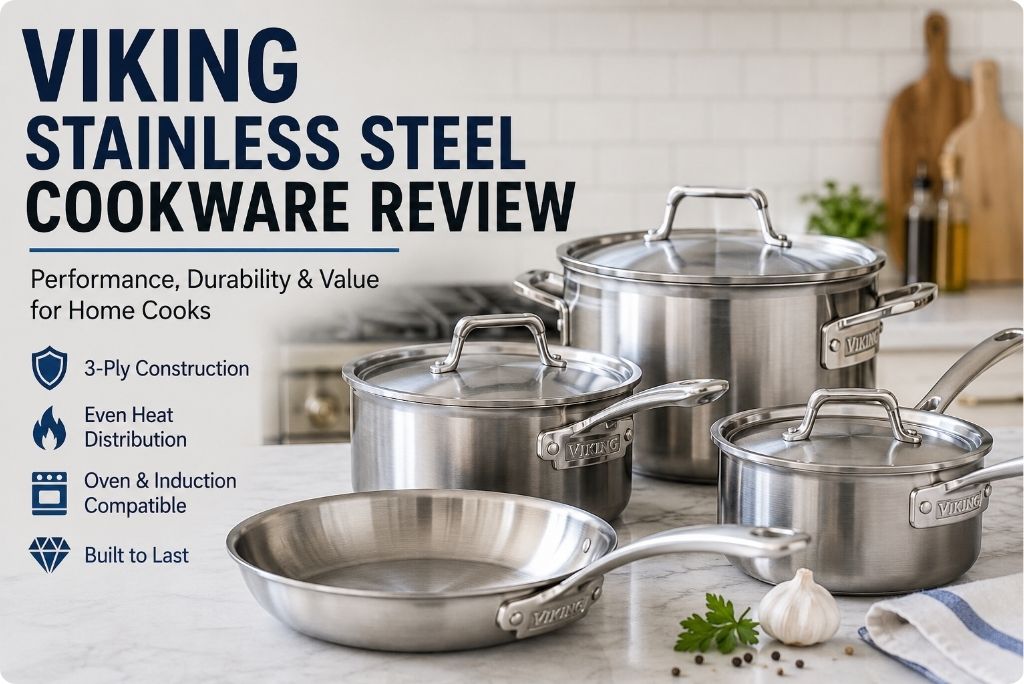
Viking Stainless Steel Cookware Review: Is It Worth Buying?
Buying premium stainless steel cookware is a long-term decision. A good set can stay in your kitchen for years, but a high price does not automatically mean better cooking results. That is why choosing the right cookware requires more than looking at the brand name or the number of layers in the pan.
In this Viking stainless steel cookware review, we look at the things that matter most in everyday cooking: construction, heat control, searing, food release, handling, cleaning, cooktop compatibility, durability, and overall value.
The short version is this: Viking stainless steel cookware can be a strong choice for home cooks who want durable, versatile pans and are comfortable learning how to cook with stainless steel. But it is not the right fit for everyone. Buyers who want effortless nonstick performance or the lowest possible price may find better options elsewhere.
The most important question is not simply whether Viking cookware is good. It is whether its performance, design, and price make sense for the way you cook.
Quick Verdict at a Glance
Viking stainless steel cookware is best viewed as a long-term investment for cooks who want the control and durability of stainless steel rather than the convenience of a coated nonstick surface.
| Category | Verdict |
| Cooking Performance | Excellent potential for searing, sautéing, and sauce-making |
| Heat Distribution | Depends on the specific Viking line and construction |
| Heat Responsiveness | Generally strong with quality multi-layer construction |
| Build Quality | Premium-focused |
| Handle Comfort | Well-designed, but personal preference matters |
| Ease of Cleaning | Manageable with proper technique |
| Induction Compatibility | Depends on the specific model; check product specifications |
| Durability | A major reason to consider stainless steel |
| Value | Best for buyers who will use the cookware regularly |
| Learning Curve | Higher than nonstick cookware |
Our overall verdict
Viking stainless steel cookware is worth considering if you want durable cookware for serious everyday cooking and are willing to use proper stainless-steel technique.
It is a particularly good fit for people who regularly sear meat, sauté vegetables, make pan sauces, simmer foods, and move cookware from the stovetop to the oven.
It may not be the best choice if your top priorities are low price, lightweight pans, or easy food release without adjusting your cooking technique.
Who This Cookware Is Best For
Ideal Buyer Profile
Viking stainless steel cookware is most appealing to home cooks who want cookware that can handle a wide range of cooking tasks without relying on a nonstick coating.
It makes sense for someone who regularly cooks meals from scratch and wants a pan that can move from high-heat searing to making a sauce from the browned bits left behind. Stainless steel is especially useful for this style of cooking because it can tolerate high temperatures and develops fond—the browned food residue that forms on the cooking surface and adds flavor to sauces.
It is also a good option for buyers who prefer to purchase cookware for long-term use. Unlike coated cookware, quality stainless steel does not depend on a nonstick layer that can eventually wear down.
For serious home cooks, that durability can be more important than having the easiest possible cooking surface.
Who Should Skip It
Viking stainless steel cookware may not be the right choice for everyone.
You may want to consider other options if:
- You want eggs and delicate foods to release with minimal effort.
- You strongly prefer lightweight cookware.
- Your budget is limited.
- You mainly cook simple meals and do not need premium cookware.
- You do not want to learn how temperature and preheating affect stainless steel.
The key point is that stainless steel cookware rewards technique. If you expect it to behave exactly like a nonstick pan, you may be disappointed—even if the cookware itself is excellent.
What Is Viking Stainless Steel Cookware?

Brand Overview
Viking is widely known for premium kitchen products, particularly among home cooks who want equipment designed with serious cooking in mind.
Its stainless steel cookware is positioned toward buyers who want durable, versatile cookware rather than disposable or short-term kitchen products.
However, it is important not to judge every Viking pan by the Viking name alone. The brand offers different cookware products and constructions, and the details can vary between collections.
That means the exact model matters.
Product Line or Model Being Reviewed
Before buying a specific Viking cookware set, check the exact product specifications. Look at the construction, number of layers, materials, included pieces, oven rating, induction compatibility, and care instructions.
This is especially important when comparing a complete cookware set with individual pieces. A set may appear to offer better value, but only if you will actually use most of the included pans.
For many home cooks, buying a few high-use pieces individually can be a smarter investment than purchasing a large set filled with cookware that rarely leaves the cabinet.
Stainless Steel Basics
Stainless steel is popular because it is durable, versatile, and well suited to high-heat cooking.
The cooking surface itself is not naturally nonstick. That is both a strength and a weakness.
The strength is that stainless steel is excellent for browning and developing fond. The weakness is that food can stick if the pan is too cold, too hot, or not properly prepared.
Many premium stainless steel pans use multiple layers of metal. These layers are designed to improve how heat moves through the cookware and, depending on the construction, combine the strengths of different metals.
The result can be a pan that heats more evenly and responds more predictably than a basic single-layer stainless steel pan.
How We Evaluated Viking Stainless Steel Cookware
This review is based on Viking’s published product information, not a claim of secret lab testing. To keep it honest and useful, the evaluation focuses on the things a buyer actually cares about: how the construction should affect heat behavior, how easy the cookware is to live with, and whether the premium price makes sense for everyday use. That approach is especially important for stainless steel, because good results depend both on cookware design and on proper technique.
The most useful questions are practical ones: does the pan heat evenly, does it respond well when you lower the flame, can you sear with confidence, and does cleanup stay manageable after real cooking? Those are the questions that matter more than marketing language. Viking’s own descriptions point toward even heating, consistent results, and compatibility with all stovetops, so those are the areas that deserve the most attention.
Viking Stainless Steel Cookware Construction and Design
Materials and Layering
The construction of stainless steel cookware matters because it affects how heat moves through the pan.
Multi-layer cookware is generally designed to combine stainless steel with a more heat-conductive metal. The goal is to improve heat distribution while maintaining a durable cooking surface.
However, more layers do not automatically guarantee better performance.
A well-designed three-layer pan can outperform a poorly designed five-layer pan in some situations. The quality of the materials, thickness, construction, and overall design all matter.
That is why it is better to evaluate Viking cookware based on its actual cooking performance rather than assuming that a higher ply count automatically means higher quality.
Exterior and Interior Finish
A polished stainless steel finish can give cookware a clean, professional appearance, but appearance is only part of the story.
The more important questions are whether the surface remains durable, whether it is easy to clean, and whether it develops noticeable discoloration during normal use.
Some cosmetic changes are normal with stainless steel. Heat tinting, water spots, and minor discoloration do not necessarily mean the cookware is damaged.
For many owners, the goal should be maintaining good cooking performance rather than keeping the pan looking factory-new after every meal.
Base and Rim Design
The base plays an important role in stability and heat transfer.
A well-designed base should sit securely on the cooktop and distribute heat across the cooking area as evenly as practical.
The rim also affects daily use. A well-shaped pouring edge can make it easier to transfer sauces, soups, or cooking liquids without creating a mess.
These small design details may not appear important when looking at cookware online, but they become noticeable after months of regular use.
Handles and Lids
Handles should feel secure and balanced when the pan is empty and when it is loaded with food.
This is particularly important with larger skillets and sauté pans. A pan that feels comfortable in your hand when empty can become awkward when filled with several pounds of food.
Lids should also fit securely and be easy to remove when checking food.
The best cookware design is not necessarily the one with the most impressive specifications. It is the one that feels predictable and comfortable every time you use it.
Cooking Performance Review
Heat Distribution
Even heating is one of the most important qualities in stainless steel cookware.
Uneven heating can create over-browned spots while leaving other areas undercooked. This is especially noticeable when searing meat or cooking delicate ingredients.
The construction of the specific Viking cookware line should be considered here. Multi-layer designs are intended to spread heat more evenly than basic stainless steel cookware, but actual results can still depend on the pan size, burner size, and cooktop.
A useful test is to observe whether food browns consistently across the cooking surface rather than concentrating in one small area.
Heat Responsiveness
Heat responsiveness is different from heat distribution.
A pan can heat evenly but still respond slowly when you turn the burner down.
Responsive cookware is valuable when cooking foods that require precise temperature control. Sauces, reductions, and delicate ingredients can benefit from a pan that adjusts predictably when you change the heat.
For everyday cooking, this gives you more control and reduces the need to constantly move the pan away from the burner.
Searing and Browning
This is where stainless steel cookware can be especially rewarding.
When the pan is properly preheated and the food is prepared correctly, stainless steel can produce strong browning and a flavorful fond.
For example, when searing a steak, the goal is not to force the meat to release immediately. Once a good crust develops, the food often becomes easier to turn.
The same principle applies to chicken, pork, and vegetables.
This is one area where stainless steel can offer a clear advantage over many nonstick surfaces. You are not just cooking the food—you are building flavor in the pan.
Cooking Eggs and Delicate Foods
Eggs are one of the most common tests people use to judge stainless steel cookware.
The challenge is that stainless steel does not provide the same easy release as a nonstick coating.
The solution is technique.
Preheat the pan appropriately, use enough fat, control the heat, and avoid trying to move the food before it has had enough time to set.
Even with good technique, a stainless steel pan will generally require more attention than a quality nonstick pan for delicate foods.
If you cook eggs every morning and want maximum convenience, keeping a separate nonstick skillet may make more sense than expecting your stainless steel cookware to do everything.
Simmering, Boiling, and Sauces
Stainless steel cookware is highly versatile for simmering, boiling, and making sauces.
A quality pan can handle everything from reducing a cream sauce to simmering vegetables or preparing a quick pan gravy.
The biggest advantage is control.
You can start by searing ingredients, remove them, build a sauce using the browned fond, and then return the food to the pan. This creates a complete cooking process in one piece of cookware.
Deglazing Performance
Deglazing is one of the best reasons to own stainless steel cookware.
After searing meat, browned bits remain on the cooking surface. Adding wine, stock, water, or another cooking liquid helps loosen those bits and turn them into the foundation of a sauce.
This is where stainless steel cookware becomes more than just a container for food.
The ability to build fond and then deglaze the pan gives you a level of cooking flexibility that many home cooks appreciate.
Everyday Usability
Weight and Balance
Premium stainless steel cookware can feel substantial.
That can be a benefit because heavier cookware often feels stable on the cooktop, but it can also become tiring if you frequently lift or move the pan.
Think about your cooking habits.
If you regularly prepare large meals, a heavier pan may feel reassuring. If you have limited hand strength or frequently move cookware between the stove and sink, weight becomes a more important consideration.
Handle Comfort
Handle design is highly personal.
Some cooks prefer long, straight handles, while others prefer handles with more ergonomic shaping. The important thing is that the handle provides a secure grip and keeps the pan balanced.
Pay particular attention to larger pans. A handle that feels comfortable on a small skillet may not feel as good when the pan is full.
Pouring and Moving Food
A good stainless steel pan should be easy to control when transferring food or liquid.
This becomes particularly important with sauces, soups, and reductions.
If you often cook meals that move from stovetop to oven, the ability to safely transfer the cookware without changing containers can also save time and reduce cleanup.
Storage and Kitchen Fit
Large cookware sets can quickly consume cabinet space.
Before buying a complete Viking set, check how many pieces you will realistically use. A smaller collection of frequently used pans may provide better value and make your kitchen easier to organize.
For many cooks, a practical collection might center around a skillet, saucepan, sauté pan, and stockpot rather than a large set containing multiple overlapping sizes.
Cleaning and Maintenance
Is It Easy to Clean?
Stainless steel cookware is durable, but it is not always effortless to clean.
Food can stick, especially when cooking at excessive heat or using poor technique.
The good news is that stainless steel is generally forgiving. Stuck food can often be loosened with soaking, gentle scrubbing, or simmering water in the pan.
The best way to reduce cleanup is to avoid creating unnecessary buildup in the first place.
Best Cleaning Methods
For ordinary cleanup, let the pan cool enough to handle safely, then wash it with warm water and dish soap.
For stubborn residue, soaking can help. A gentle scrubber is usually enough for most everyday messes.
For more difficult stains, a small amount of baking soda can help loosen residue without relying on aggressive scraping.
Avoid treating every discoloration as a serious problem. Stainless steel cookware can develop cosmetic changes from normal cooking, and these do not always affect performance.
Dishwasher Use
Whether a particular Viking cookware product is dishwasher-safe depends on the model and manufacturer instructions.
Always check the care instructions for the exact cookware you own.
Even when dishwasher cleaning is permitted, hand washing may help preserve the appearance of the finish over time.
The important thing is to follow the specific care guidance provided with the cookware rather than assuming every stainless steel product should be treated identically.
Staining, Discoloration, and Shine
Stainless steel may develop rainbow-colored heat marks, white mineral spots, or darker areas after repeated cooking.
These are usually cosmetic.
Regular cleaning can reduce their appearance, but perfection is not necessary for good cooking.
If your cookware performs well and remains structurally sound, a few visual marks are generally a minor concern compared with actual warping, loose handles, or other functional problems.
Induction and Oven Compatibility
Induction Performance
Induction compatibility should be checked for the exact Viking model you are considering.
If you use induction, do not rely solely on the brand name. Verify that the specific cookware is designed for your cooktop.
Induction cookware also needs a suitable magnetic base or construction to work correctly with an induction burner.
Oven Safety
Oven temperature limits vary by product and may depend on the handles, lids, or other components.
Always follow the manufacturer’s specifications for the exact model.
Oven compatibility is valuable because it allows you to start a dish on the stovetop and finish it in the oven without transferring food to another pan.
Versatility Across Cooktops
For buyers who may move between different cooking surfaces, compatibility is worth checking before purchase.
Consider whether the cookware works with:
- Gas
- Electric
- Glass-top
- Induction
This is particularly important if you expect to change cooktops in the future.
Value for Money
Viking sits in the premium cookware space, so the value question is not whether it is cheap. The real question is whether the build, cooking performance, and versatility justify the cost. Based on the brand’s current pages, Viking is selling performance, durability, induction compatibility, and polished design together as one package. That is valuable if those are the exact things you care about.
The downside is that premium stainless steel can be more expensive than many buyers need. If you only cook occasionally, or if you do not care about professional-style browning and deglazing, you may not fully use what this cookware offers. So the value is strong for the right buyer, but not automatically strong for everyone. That is the most honest way to look at it.
Viking vs. Other Stainless Steel Cookware Brands
Viking vs. All-Clad
All-Clad is one of the best-known names in premium stainless steel cookware, making it a natural comparison.
The comparison should focus on actual differences in construction, heating behavior, weight, handle design, warranty, and price rather than simply choosing a winner based on brand reputation.
For many buyers, the decision may come down to which pan feels better in the hand and which construction best matches their cooking style.
Viking vs. Made In
Made In is another brand frequently considered by shoppers looking for premium stainless steel cookware.
The key comparison points include construction, weight, responsiveness, handling, and price.
A buyer should also consider which pieces are available and whether they prefer purchasing a set or building a collection one pan at a time.
Viking vs. Tramontina or Cuisinart
This comparison is especially important for budget-conscious buyers.
Less expensive cookware can sometimes deliver very good results, particularly for cooks who do not need premium finishing or advanced design details.
The question is therefore not simply whether Viking performs better.
The better question is:
Is the performance difference large enough to justify the additional cost for you?
For some serious cooks, the answer will be yes. For others, a more affordable stainless steel set may offer better overall value.
Pros and Cons
Pros
- Durable stainless steel cooking surface
- Suitable for high-heat cooking when used correctly
- Strong potential for searing and browning
- Excellent for developing fond and making pan sauces
- Versatile for stovetop cooking
- Can be a long-term cookware investment
- Does not rely on a nonstick coating for food release
Cons
- Typically more expensive than basic stainless steel cookware
- Requires more cooking technique than nonstick
- Food can stick if temperature and technique are not controlled
- Some pieces may feel heavy for everyday handling
- Exact features and compatibility vary by product line
The biggest advantage is versatility and durability.
The biggest drawback is that stainless steel asks you to participate in the cooking process. You have to manage heat and timing rather than expecting the cookware to do everything for you.
Best Ways to Use Viking Stainless Steel Cookware
Best Cooking Jobs for This Cookware
Stainless steel cookware is especially well suited to:
- Searing steak and other meats
- Browning chicken
- Sautéing vegetables
- Making pan sauces
- Deglazing
- Simmering
- Boiling
- Reducing sauces
- Finishing dishes in the oven, when the specific cookware is oven-safe
These are the cooking tasks where durability and browning performance matter more than effortless food release.
Cooking Jobs Where It May Not Be Ideal
Stainless steel is less convenient for foods that are naturally prone to sticking.
Eggs, delicate fish, and certain starchy foods can require more attention.
That does not make stainless steel a bad choice. It simply means you may benefit from using different cookware for different tasks.
A well-equipped kitchen does not need every pan to do everything.
A stainless steel skillet can handle high-heat cooking and sauces, while a separate nonstick pan can make breakfast eggs easier.
Common Mistakes People Make With Stainless Steel Cookware
Overheating the Pan
One of the most common mistakes is using excessive heat.
More heat does not always mean faster cooking. It can cause food to burn, oil to smoke, and ingredients to stick.
Start with moderate heat and increase it only when necessary.
Not Preheating Properly
A cold pan can create poor cooking results.
Preheating helps the cooking surface reach a stable temperature before ingredients are added.
The goal is not to make the pan dangerously hot. It is to create a controlled cooking environment.
Using Too Little Oil or the Wrong Technique
Stainless steel generally requires more attention to cooking fat than a nonstick surface.
Use enough oil for the food you are cooking and allow the pan and ingredients to reach the right temperature.
When searing meat, avoid repeatedly moving it around. Give the food time to brown and develop a crust.
Expecting Nonstick Behavior
This is perhaps the most important lesson.
Stainless steel is not supposed to behave exactly like nonstick cookware.
Its strengths are durability, browning, high-heat cooking, and versatility.
Once you understand that difference, stainless steel becomes much easier to use.
Final Verdict
Viking stainless steel cookware looks like a strong premium option for home cooks who want durability, even heating, induction compatibility, and real cooking performance. The brand’s current official pages make a convincing case for a cookware line that can handle everyday meals, high-heat searing, and oven finishing with confidence.
It is not the best choice for everyone. If you want the easiest possible cleanup, the lightest pan, or the lowest price, there are better fits. But if you want stainless steel cookware that feels built for serious use and you are willing to learn proper technique, Viking is worth a close look. That is the simplest and fairest conclusion.
FAQ
Is Viking stainless steel cookware good?
Yes, it appears to be a well-built premium option based on Viking’s current 3-ply construction, even-heating claims, induction compatibility, and oven-safe design. It is especially appealing for cooks who want durable cookware for real-world use.
Is Viking cookware worth the money?
It can be, but mainly for buyers who will use its strengths. If you cook often, like stainless steel, and want a long-term set, the value is stronger than it is for casual users.
Does Viking stainless steel cookware stick?
Like most stainless steel cookware, it can stick if you use poor technique or overheating. With proper preheating and oil control, it should perform much better.
Is Viking cookware induction compatible?
Yes. Viking states that its stainless steel cookware works on all stovetops, including induction.
Is Viking cookware dishwasher-safe?
The pages reviewed here emphasize easy-to-clean construction and stainless steel care, but as with most premium cookware, hand washing with mild soap and a soft sponge is the safest everyday approach for preserving the finish.
How do you clean Viking stainless steel cookware?
Start with warm water, mild soap, and a soft sponge. For stuck-on residue, soaking first and using baking soda or vinegar-based methods can help loosen the mess.
How does Viking compare with All-Clad?
Both sit in the premium stainless steel space, but the most important comparison is whether you want Viking’s current combination of polished design, induction support, and premium positioning. The better choice depends on your budget, comfort with stainless steel, and cooking style.