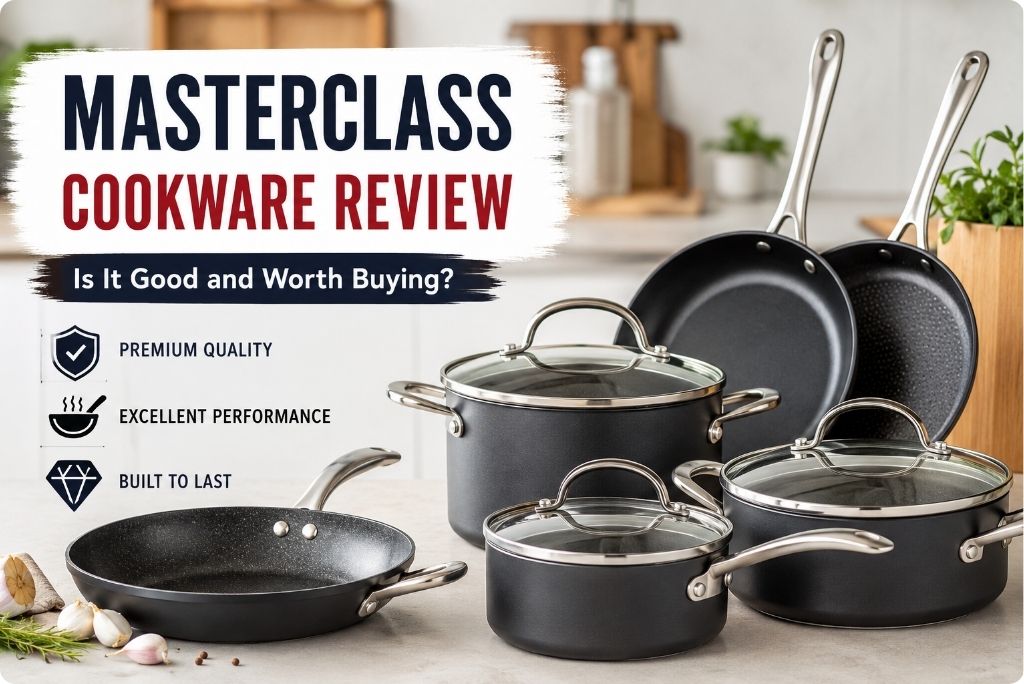
MasterClass Cookware Review: Is It Good and Worth Buying?
Choosing new cookware can be harder than it looks. A pan may have an attractive design and a reasonable price, but that does not tell you how well it will cook, how long it will last, or whether it will suit your kitchen.
This MasterClass cookware review looks at the things that matter most before you buy: materials, build quality, cooking performance, durability, safety, maintenance, compatibility, and value for money.
One important point is that MasterClass sells different cookware collections and product types. A stainless steel saucepan should not be judged in exactly the same way as a non-stick frying pan. Features such as induction compatibility, oven temperature limits, dishwasher safety, and coating type can also vary between products.
So, rather than treating the entire range as one identical product, this review focuses on the qualities shoppers should look at across the range and explains where MasterClass cookware may make sense—and where you may want to consider alternatives.
MasterClass Cookware Review at a Glance
MasterClass cookware is aimed mainly at home cooks who want practical cookware for everyday meals without automatically moving into the premium price range.
The biggest question is not simply whether MasterClass cookware is “good.” The more useful question is whether it offers the right combination of performance, durability, convenience, and price for your cooking habits.
| Feature | What to Know |
| Cookware types | Frying pans, saucepans, sauté pans, stockpots, casseroles, and sets, depending on the collection |
| Materials | Varies by product and collection |
| Non-stick options | Available in selected cookware lines |
| Stainless steel options | Available in selected cookware lines |
| Induction compatibility | Must be checked for the specific product |
| Oven compatibility | Varies by product, handle, lid, and temperature limit |
| Dishwasher compatibility | Varies by product and manufacturer instructions |
| Best suited for | Everyday home cooking and practical kitchen use |
| Main strength | A broad selection with options for different cooking needs |
| Main limitation | Product specifications and performance can vary across the range |
| Overall value | Depends heavily on the specific collection and its price |
What Is MasterClass Cookware?
MasterClass is a cookware and kitchenware brand offering a range of products designed for everyday cooking. Depending on the collection, shoppers may find frying pans, saucepans, sauté pans, stockpots, casserole-style cookware, and cookware sets.
The range can include different materials and construction methods, so there is no single answer that describes every MasterClass product equally well.
For example, the priorities for a non-stick frying pan are usually easy food release and simple cleanup. A stainless steel pan, on the other hand, may be chosen for searing, browning, and high-temperature cooking. These products can both be useful, but they serve different purposes.

This is why it is important to look beyond the brand name when making a buying decision.
MasterClass cookware is generally most relevant to home cooks looking for practical kitchen equipment for regular meals. If your needs are straightforward—such as frying eggs, sautéing vegetables, cooking sauces, or preparing family meals—the range may offer suitable choices.
The question becomes whether the particular product you are considering gives you enough performance and durability for its price.
MasterClass Cookware Materials and Build Quality
The material and construction of cookware have a major effect on how it performs. They influence how quickly a pan heats, how evenly it cooks, how well it retains heat, and how much care it needs.
Because MasterClass offers different products, always check the specifications of the exact pan or set you are buying.
Materials and Construction
Cookware may use stainless steel, aluminum, non-stick surfaces, or combinations of materials. Each has different strengths.
Stainless steel is valued for its durability and ability to handle browning and searing. It can also be suitable for higher-heat cooking, provided the product’s instructions allow it.
Aluminum is often used because it heats quickly and can distribute heat effectively. It may also be combined with other materials to balance heat performance with durability.
Non-stick cookware is designed primarily for easy food release and convenient cooking. It is particularly useful for foods such as eggs, pancakes, delicate fish, and other ingredients that can easily stick to a cooking surface.
The construction matters just as much as the material itself. A thicker or layered base may help spread heat more evenly, while a poorly designed base can create hot spots even when the material itself is a good heat conductor.
For this reason, don’t judge cookware solely by the words “stainless steel” or “aluminum” on the product description. Look at how those materials are actually used.
Build Quality and Design
A well-made pan should feel stable and balanced rather than flimsy. The base should sit securely on the cooktop, and the handle should feel firmly attached.
Pay attention to the details that are easy to overlook:
- Does the pan feel balanced when lifted?
- Does the handle feel secure?
- Is the lid a good fit?
- Does the base sit flat?
- Is the cookware comfortable when full?
These details become much more important during everyday use.
A pan that looks impressive in a product photograph but becomes awkward to handle when filled with food may not be a good choice for your kitchen.
Handles and Everyday Usability
Handle design is an important part of cookware quality.
A comfortable handle should give you a secure grip and enough control to move the pan safely. Balance also matters. A large frying pan with a heavy handle can feel awkward, while a well-balanced pan is easier to control.
Weight is another consideration. Heavier cookware may feel more substantial and can sometimes offer better heat retention, but too much weight can make it difficult to lift or pour.
If you cook large meals regularly, think about how the cookware will feel when it is full—not just when you first pick it up in a store or unpack it at home.
How Does MasterClass Cookware Perform?
Cooking performance is where cookware earns its place in the kitchen.
A pan can have attractive specifications, but what matters most is how it behaves when you actually cook with it.
Heat Distribution
Even heat distribution helps prevent food from cooking too quickly in one area while remaining undercooked in another.
This matters when frying eggs, sautéing vegetables, cooking meat, or preparing sauces. A pan with uneven heating may create hot spots that lead to burning or inconsistent results.
The construction of the cookware plays a major role here. The base design, material thickness, and any layered construction can all influence how heat moves through the pan.
When evaluating a MasterClass product, look for evidence of how its specific construction is designed to manage heat rather than assuming every product in the range performs identically.
Heat Control and Responsiveness
Good cookware should respond predictably when you change the heat.
A pan that heats quickly can be convenient when you need to start cooking fast. However, the ability to lower the temperature is equally important. If a pan stays extremely hot for too long, delicate foods and sauces can be harder to control.
For everyday cooking, you want a balance between:
- Fast enough heating
- Even temperature distribution
- Good heat retention
- Predictable response when adjusting the burner
The right balance depends on the type of cookware. A heavy pan may retain heat well for searing, while a lighter pan may respond more quickly to changes.
Everyday Cooking Performance
For most home cooks, cookware is used for simple meals rather than restaurant-style cooking. That makes everyday performance the most useful measure.
A suitable frying pan should handle common tasks such as eggs, vegetables, fish, chicken, and quick meals without becoming difficult to manage.
Non-stick cookware is particularly useful when easy food release is the priority. Stainless steel is often better suited to cooks who want to develop browning and use techniques such as deglazing.
For sauces and simmering, consistent heat is important. You want enough control to maintain a gentle simmer without creating aggressive hot spots.
The best choice therefore depends partly on how you cook. There is no single cookware material that is perfect for every task.
High-Heat Cooking
High-heat cooking requires more care, particularly with non-stick cookware.
If you are searing meat or cooking at high temperatures, check the manufacturer’s instructions for the specific product. Do not assume that a cookware set with an oven-safe label can automatically withstand every stovetop or oven temperature.
For non-stick cookware, unnecessary overheating should generally be avoided. Stainless steel may be more suitable for cooks who regularly use high heat, but the manufacturer’s instructions should still be followed.
MasterClass Non-Stick Cookware: How Good Is It?
If you are considering a MasterClass non-stick pan, the most important question is simple: does food release easily and does that performance last?
Food Release and Cooking Performance
A good non-stick surface should make it easier to cook foods that tend to stick.
Eggs, pancakes, fish, and delicate foods are common examples. A reliable non-stick surface can also reduce the amount of cooking oil needed and make cleanup much easier.
However, non-stick performance should be judged over time, not just during the first few uses.
A pan that releases eggs perfectly when new but loses that performance quickly is not necessarily good value.
Non-Stick Durability
The lifespan of a non-stick coating depends on how the cookware is used.
High heat, abrasive cleaning, unsuitable utensils, and careless storage can all contribute to premature wear.
Using appropriate utensils and following the manufacturer’s care instructions can help protect the cooking surface.
You should also be realistic about the nature of non-stick cookware. Even a good non-stick pan is generally not the same long-term investment as a quality stainless steel pan. The cooking surface may eventually lose performance and need replacing.
Care and Maintenance
To protect a non-stick surface:
- Avoid unnecessary high heat.
- Use utensils recommended by the manufacturer.
- Follow the cleaning instructions.
- Avoid abrasive scrubbers unless specifically permitted.
- Store pans carefully to prevent surface damage.
If you stack cookware, consider how the cooking surfaces contact each other. Even small amounts of repeated friction can contribute to visible wear over time.
MasterClass Stainless Steel Cookware: How Does It Perform?
This section applies to MasterClass stainless steel cookware where relevant.
Stainless steel cookware is generally chosen for durability and versatility rather than effortless food release.
Searing and Browning
Stainless steel can be a strong choice for searing meat and browning ingredients.
When used correctly, it can help create browned food residue that can be loosened with liquid to build flavor into sauces.
The key is temperature control. If the pan is too cold or the food is added too early, sticking can become a problem. If it is overheated, food may burn.
Ease of Use
Stainless steel has a learning curve that non-stick cookware does not.
Preheating the pan correctly, using an appropriate amount of oil, and controlling the cooking temperature can make a major difference.
This is not necessarily a weakness. For cooks who enjoy learning proper cooking techniques, stainless steel can be more versatile for high-heat cooking and browning.
Long-Term Durability
One of the biggest advantages of stainless steel is that it does not depend on a non-stick coating for its cooking surface.
That means there is no coating to gradually wear away in the same way. The cookware may still develop discoloration, scratches, or stains, but these are often cosmetic rather than signs that the entire cooking surface has failed.
With appropriate care, stainless steel can be a long-lasting option for everyday cooking.
Is MasterClass Cookware Safe?
Cookware safety should be evaluated using reliable information rather than marketing claims or online rumors.
The first step is to identify the materials used in the specific product. Check the manufacturer’s product information and care instructions for details about the cooking surface, temperature limits, and intended use.
For non-stick cookware, use the product according to the manufacturer’s instructions. Avoid unnecessary overheating, and replace cookware if the cooking surface is significantly damaged or the manufacturer recommends replacement.
If you have specific concerns about food-contact materials or coatings, look for information from appropriate regulatory and food-safety authorities rather than relying on social media claims.
Safe cookware use also depends on everyday habits. Never leave an empty pan heating unattended, use appropriate oven temperatures, and handle hot cookware carefully.
Most importantly, don’t assume that every MasterClass product has identical safety characteristics. Different cookware lines can use different materials and construction.
Cooktop and Oven Compatibility
Compatibility is one of the easiest things to overlook when buying cookware.
Is MasterClass Cookware Induction Compatible?
Not every cookware product is automatically suitable for induction cooking.
If you use an induction cooktop, check the exact product specifications before purchasing. Look for clear confirmation that the cookware is designed for induction.
The base of the cookware is particularly important because induction cooking relies on magnetic interaction between the cooktop and a suitable cookware base.
If induction compatibility is important to you, don’t rely on a general statement about the brand. Confirm the specific pan or set.
Is It Suitable for Gas, Electric, and Ceramic Cooktops?
Many cookware products are designed to work with common cooktop types, but compatibility should still be confirmed for the individual product.
Gas cooktops may expose cookware to direct flame, while electric and ceramic surfaces transfer heat differently. A flat, stable base is especially useful on smooth cooktops.
Is MasterClass Cookware Oven Safe?
Oven safety is product-specific.
Check:
- Maximum oven temperature
- Handle material
- Lid material
- Whether the lid has a lower temperature limit
- Whether the product can safely move from stovetop to oven
Never assume that because a pan is oven-safe, its lid or handle can withstand the same temperature.
How Durable Is MasterClass Cookware?
Durability depends heavily on the type of cookware you buy and how you use it.
A stainless steel pan and a non-stick frying pan have different expected wear patterns. Stainless steel may show scratches or discoloration while remaining functional, whereas a damaged non-stick surface may eventually affect food release.
Everyday habits also matter.
Using excessive heat, dropping cookware, stacking pans without protection, or cleaning surfaces with overly abrasive materials can shorten the useful life of cookware.
Warping is another concern with any cookware. Sudden temperature changes can place stress on the material, so avoid exposing extremely hot cookware to cold water unless the manufacturer specifically indicates that it is safe.
The most useful way to think about durability is not simply, “How many years will this last?” Instead, ask:
“How well will this cookware continue to perform if I use and maintain it correctly?”
That is a more realistic measure of long-term value.
Cleaning and Maintenance
Ease of cleaning can make a noticeable difference in how much you enjoy using cookware.
Non-stick cookware is usually convenient because food releases more easily. Stainless steel can require more effort when food becomes stuck, but proper temperature control can reduce this problem.
Always follow the manufacturer’s cleaning instructions.
If a product is listed as dishwasher-safe, that does not necessarily mean frequent dishwasher use will preserve its appearance forever. High temperatures, detergents, and repeated washing can affect some finishes over time.
For non-stick cookware, gentle cleaning is generally the safer approach. Avoid unnecessary abrasive scrubbing that could damage the cooking surface.
For stainless steel, discoloration and stuck food can often be managed with appropriate cleaning methods rather than aggressive scrubbing.
Storage also matters. If cookware is stacked, protect surfaces where necessary to reduce scratches and unnecessary wear.
MasterClass Cookware Pros and Cons
Pros
- Offers cookware options for different cooking styles and budgets.
- Provides both convenience-focused and performance-focused cookware options, depending on the collection.
- Can be suitable for everyday home cooking.
- Non-stick options can make delicate foods and cleanup easier.
- Stainless steel options can offer greater long-term versatility where available.
- A broad range makes it possible to choose cookware based on specific needs.
Cons
- Performance and specifications can vary between collections.
- Induction compatibility must be confirmed for the specific product.
- Oven and dishwasher suitability may differ between products.
- Non-stick cookware requires more careful handling to protect the cooking surface.
- Some shoppers may prefer higher-end cookware for demanding or professional-level use.
The biggest takeaway is that the MasterClass name alone does not tell you everything you need to know. The individual cookware line matters.
MasterClass Cookware vs. Alternatives
Comparing cookware brands is useful only when you compare products that serve similar purposes.
MasterClass vs. Budget Cookware
The key question is whether spending more on MasterClass gives you better construction, cooking performance, or durability than the cheapest cookware available.
If a MasterClass product has a more substantial build or better cooking surface than basic budget cookware, the additional cost may be worthwhile.
However, price alone does not guarantee better performance. Always compare actual materials, construction, features, and care requirements.
MasterClass vs. Mid-Range Cookware
This is likely to be the most relevant comparison for many shoppers.
At this level, the differences may come down to:
- Heat distribution
- Construction quality
- Coating performance
- Handle design
- Warranty
- Long-term durability
A MasterClass product can make sense if it offers the features you actually need without charging for extras you will never use.
Read More: Viking Stainless Steel Cookware Review
MasterClass vs. Premium Cookware
Premium cookware may offer more advanced construction, heavier materials, better heat control, or longer-term durability.
But not every home cook needs those advantages.
If you cook simple meals several times a week, you may not benefit enough from premium construction to justify a much higher price.
On the other hand, serious home cooks who frequently sear, reduce sauces, or use high heat may appreciate the additional performance of higher-end cookware.
The right choice depends on how much you cook and what you expect from your pans.
Is MasterClass Cookware Worth the Money?
MasterClass cookware is worth considering when the product’s performance and construction match your cooking needs at a price you are comfortable paying.
Don’t judge value only by the initial price.
A better approach is to consider:
Purchase price + performance + maintenance + expected lifespan + replacement cost
For example, a cheaper non-stick pan may initially seem like a bargain. But if its coating loses performance quickly, replacing it several times may cost more in the long run.
Conversely, a more expensive pan may not be good value if you rarely cook and don’t need its additional features.
MasterClass cookware is most likely to offer good value when you choose a product based on how you actually cook rather than buying the largest set simply because it appears to contain more pieces.
Who Should Buy MasterClass Cookware?
Best For
MasterClass cookware may be a good fit for:
- Everyday home cooks who need practical cookware for regular meals.
- Beginners who want to upgrade from very basic cookware.
- Budget-conscious shoppers who still want more features than the cheapest options.
- Cooks who prefer to choose between non-stick convenience and stainless steel versatility.
- People who want cookware suited to their specific cooking needs rather than professional-level equipment.
Consider Alternatives If
You may want to look elsewhere if:
- You cook at a professional or very high level every day.
- You want premium multi-layer construction.
- You need specialized cookware for demanding cooking techniques.
- You have very specific requirements for materials or coatings.
- You are willing to pay significantly more for long-term performance and premium construction.
That does not mean MasterClass cookware is unsuitable. It simply means that your priorities may justify looking at other options.
How to Choose the Right MasterClass Cookware
Start with your cooktop.
If you use induction, confirm compatibility before buying. If you cook mainly on gas, think about how the cookware handles direct heat and whether the base remains stable.
Next, consider your cooking style.
If you mostly cook eggs, pancakes, fish, and quick meals, non-stick cookware may be the more convenient option.
If you frequently sear meat, brown ingredients, or make pan sauces, stainless steel may better match your cooking style.
You should also consider whether you really need a cookware set.
Sets can be convenient, but they sometimes include pieces you rarely use. Buying individual pans may give you better value if you already know which sizes and shapes you need.
Before purchasing, check:
- Cooktop compatibility
- Oven temperature limits
- Lid and handle restrictions
- Dishwasher guidance
- Cooking surface and coating
- Dimensions and capacity
- Warranty
- Care requirements
The best cookware is not necessarily the one with the most pieces. It is the cookware that fits your kitchen and the meals you actually prepare.
Final Verdict: Is MasterClass Cookware Good?
MasterClass cookware is a good choice for everyday home cooks looking for practical performance at a reasonable price. Its quality and features vary by collection, so always check the specific product before buying.
Overall, MasterClass cookware is worth considering if you want reliable cookware for regular home cooking without paying premium prices. However, serious cooks seeking professional-level performance may prefer a higher-end alternative.
Frequently Asked Questions
Is MasterClass cookware good?
MasterClass cookware can be a good option for everyday home cooking, but the range includes different products with different materials and construction. Check the specific cookware line before making a decision.
Is MasterClass cookware worth the money?
It can be worth the money when the cookware offers the performance, durability, and features you need at a competitive price. Value depends on the specific product and how you plan to use it.
Is MasterClass cookware safe?
Cookware should be used according to the manufacturer’s instructions, including recommended temperatures and care methods. For specific safety concerns, check the product’s material information and guidance from reliable food-contact and regulatory authorities.
Is MasterClass cookware induction compatible?
Some MasterClass cookware may be suitable for induction, but compatibility varies by product. Always check the specifications of the exact pan or cookware set before buying.
Can MasterClass cookware go in the oven?
Oven compatibility depends on the specific product. Check the maximum temperature and whether the handles and lids have separate temperature restrictions.
Is MasterClass cookware dishwasher safe?
Some products may be dishwasher-safe, while others may require hand washing. Follow the care instructions for the specific cookware you own.
How long does MasterClass cookware last?
There is no single lifespan that applies to the entire MasterClass range. Stainless steel cookware can generally remain usable for many years with proper care, while non-stick cookware may eventually lose coating performance. Heat, utensils, cleaning, and storage habits all affect longevity.