Can I Use Induction Cookware on a Gas Stove? Complete Guide
If you’ve recently bought induction-compatible cookware, you might be wondering: Can I use induction cookware on a gas stove?
The short answer is yes. Induction cookware works perfectly well on a gas stove. In fact, most induction-compatible pots and pans are designed to work on multiple cooktops, including gas, induction, electric coil, ceramic glass, and halogen.
The confusion usually comes from the name. Many people assume “induction cookware” is made only for induction cooktops. That’s not true. Induction cookware simply has a magnetic base that allows it to work on induction stoves, but it can still be heated normally by a gas flame.
In this guide, you’ll learn why induction cookware works on gas stoves, whether it’s safe, how it performs, common mistakes to avoid, and how to choose cookware that works well on both gas and induction.
Quick Answer
Yes, you can safely use induction cookware on a gas stove.
Gas burners heat cookware with an open flame, so they don’t require magnetic cookware. Since induction cookware is built from durable, heat-resistant materials like stainless steel, cast iron, or carbon steel, it performs just as well on gas as it does on induction.
To get the best results:
- Use a flame that stays under the base of the pan.
- Avoid heating an empty pan over high heat.
- Preheat gradually instead of using maximum heat immediately.
- Follow the manufacturer’s care instructions.
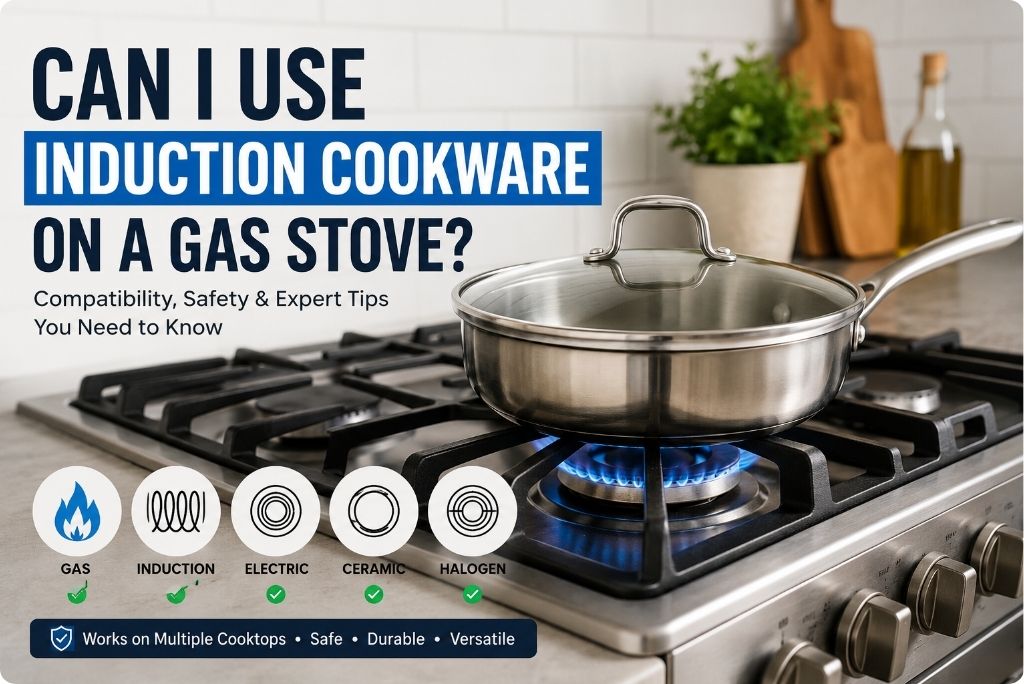
Induction Cookware Compatibility at a Glance
| Cooktop Type | Compatible? | Notes |
| Gas | ✅ Yes | Excellent performance |
| Induction | ✅ Yes | Designed for it |
| Electric Coil | ✅ Yes | Works well |
| Ceramic Glass | ✅ Yes | Compatible |
| Halogen | ✅ Yes | Compatible |
One of the biggest advantages of induction-compatible cookware is its versatility. A quality pan can move from a gas stove to an induction cooktop without any changes.
What Is Induction Cookware?
Induction cookware is cookware made from magnetic materials or equipped with a magnetic base. Unlike gas or electric stoves, induction cooktops create heat through a magnetic field. If the cookware isn’t magnetic, the cooktop won’t recognize it.
The important thing to understand is that being induction-compatible doesn’t limit the cookware to induction cooking. It simply means the cookware meets one additional requirement—a magnetic base.
What Is Induction Cookware?
Induction cookware is cookware that works on an induction cooktop because it has a magnetic base. Induction stoves do not heat a pan with an open flame or a hot electric coil. Instead, they create heat through a magnetic field, and only cookware made with the right material will respond properly.

That is why induction-compatible pans are usually made from stainless steel, cast iron, carbon steel, or layered construction that includes a magnetic base. The cookware is designed to react to induction heat, but that does not mean it is limited to induction use.
In simple terms, induction cookware is not “special” in a way that makes it unusable elsewhere. It is simply built to be flexible enough for induction and, in many cases, other cooktops too.
Common Materials Used
Some of the most common induction-compatible materials include:
- Stainless steel
- Fully clad stainless steel
- Cast iron
- Carbon steel
- Enameled cast iron
Pure aluminum and pure copper do not work on induction unless they have a magnetic layer or base added to them. On gas, however, the cookware material does not need to be magnetic at all, because the flame heats the pan directly.
Why Induction Cookware Works on a Gas Stove
Gas stoves heat cookware in a very simple way: the flame touches the bottom of the pan and transfers heat into the metal. That means the cookware does not need to be magnetic to work on gas.
This is why induction cookware usually works just fine on a gas stove. The magnetic base that makes it induction-compatible does not get in the way of gas cooking. The pan still absorbs and spreads heat like any other quality piece of cookware.
What matters more on gas is the quality of the pan itself. A well-made pan will heat more evenly, resist warping, and hold up better over time. A lower-quality pan may still work, but it may not perform as well.
Does Induction Cookware Cook Differently on Gas?
Yes, sometimes it does, but not in a bad way. The difference usually comes from the stove type, not from the cookware being “induction.”
Gas and induction heat in different ways. Induction is very fast and direct, while gas heats the pan through flame and air. Because of that, induction cookware may feel a little slower to preheat on gas than it does on induction. That is normal.
A good pan will still cook well on gas. For example:
- When searing meat, a heavy stainless steel or cast iron pan can hold heat nicely.
- When simmering sauces, a pan with even heat distribution helps prevent hot spots.
- When frying eggs or sautéing vegetables, moderate gas heat often gives good control.
The real difference is usually about control and heat management. Gas gives you visible flame and wide temperature ranges, while induction reacts very quickly to setting changes. Cookware that performs well on one usually performs well on the other, but the cooking experience can still feel slightly different.
Heating Speed
Gas usually heats cookware a little more gradually than induction. That is not a problem, but it does mean you may need a little patience when preheating. If you rush the process with a large flame, the bottom of the pan can heat too fast, which may lead to warping or discoloration over time.
Heat Distribution
Heat distribution depends mostly on the construction of the pan. Fully clad cookware tends to spread heat more evenly than cheaper pans with thin bottoms. That matters on gas because flame contact is not always perfect even across the entire base.
Temperature Control
Gas gives you immediate visual control, which many home cooks like. If the flame is too high, you can lower it right away. If the flame is too low, you can increase it quickly. The cookware itself does not create any special limitation here.
Is It Safe to Use Induction Cookware on a Gas Stove?
Yes, it’s completely safe.
Quality induction cookware is built to handle high cooking temperatures and is usually tested for use on multiple heat sources.
Manufacturers expect many customers to use the same cookware on different cooktops throughout its lifetime.
As long as you use the cookware properly, there’s no safety concern unique to using it on gas.
Why It’s Safe
Most induction cookware features:
- Durable construction
- Thick bases for stability
- Heat-resistant materials
- Multi-cooktop compatibility
- Oven-safe designs (depending on the model)
Always check the manufacturer’s instructions because temperature limits, handle materials, and oven-safe ratings vary between brands.
Can a Gas Flame Damage Induction Cookware?
Usually, no. A gas flame will not automatically damage induction cookware. Many high-quality pans are built specifically to handle gas burners.
Still, there are some situations that can cause wear over time.
What Can Damage Cookware?
- Flames that climb too far up the sides of the pan
- Very high heat used for long periods
- Heating an empty pan too aggressively
- Sudden temperature changes, like putting a hot pan into cold water
- Using cookware that is already warped or damaged
These issues do not mean induction cookware is unsafe on gas. They simply mean the cookware should be treated with normal care.
A little discoloration on the bottom of stainless steel pans can happen over time, especially with gas. That is usually cosmetic, not a sign of failure. It may not look perfect, but the pan can still cook very well.
Pros and Cons of Using Induction Cookware on a Gas Stove
Induction cookware is often a smart choice for gas stove users, but like any cookware, it has strengths and limits.
| Pros | Cons |
| Works on multiple cooktops | Often costs more than basic cookware |
| Usually durable and long-lasting | May discolor slightly over time |
| Good for future cooktop changes | Heavier than some lightweight pans |
| Often made with strong materials | Needs proper heat control on gas |
For many people, the biggest advantage is flexibility. If you use gas now but may move to induction later, induction-compatible cookware can save you from buying a whole new set.
Best Types of Induction Cookware for Gas Stoves
Not every induction pan is made the same way. Some materials and constructions are better on gas than others.
Stainless Steel
Stainless steel is one of the best choices for gas cooking, especially when the pan has a solid base or a fully clad design. It is durable, easy to maintain, and good for everyday cooking.
It works well for:
- Sautéing vegetables
- Making sauces
- Boiling pasta
- Pan-searing proteins
High-quality stainless steel cookware is especially useful because it can handle steady heat and frequent use without much trouble.
Cast Iron
Cast iron is excellent on gas because it holds heat very well. It takes longer to heat up, but once it is hot, it stays hot. That makes it ideal for searing and browning.
It works well for:
- Steaks
- Roasted chicken
- Cornbread
- One-pan meals
The main thing to remember is that cast iron is heavy and can get very hot very quickly, so it should be used carefully.
Carbon Steel
Carbon steel is a good middle ground between stainless steel and cast iron. It heats faster than cast iron and is lighter, but it still holds heat well.
It works well for:
- Stir-frying
- High-heat sautéing
- Eggs
- Quick cooking
Many cooks like carbon steel because it feels responsive on gas and can handle high heat without losing performance.
Enameled Cast Iron
Enameled cast iron also works well on gas. It is great for slow cooking, braising, soups, and recipes that need steady heat.
It works well for:
- Stews
- Braises
- Soups
- Simmered sauces
Because the enamel coating changes the care routine, it is a good choice for cooks who want cast iron performance without seasoning the pan.
Tips for Using Induction Cookware on a Gas Stove
A few simple habits can make your cookware last longer and cook better.
Use the Correct Flame Size
The flame should match the base of the pan. If the flame is too large, it can wrap around the sides of the cookware and waste heat. It can also discolor the outer surface and make the handles hotter than necessary.
Preheat Gradually
A moderate flame is usually better than a huge one. Let the pan warm up slowly, especially if it is thick or heavy. This helps prevent stress on the metal and gives you better control.
Avoid High Heat Unless You Really Need It
Many home cooks use more heat than they need. For eggs, vegetables, sauces, and many everyday meals, medium heat is enough. High heat is helpful for searing or boiling, but it is not the best default setting.
Do Not Heat an Empty Pan for Too Long
An empty pan can get hot very quickly on gas. If it stays empty over high heat, the bottom can warp or discolor. Add oil or food when appropriate, and do not let the pan sit over a strong flame for no reason.
Clean Burners Regularly
A clean burner gives a more even flame. If the burner is dirty or clogged, the heat may not spread properly under the pan.
Lift, Don’t Drag
Dragging cookware across grates can scratch both the pan and the stove. Lifting it is safer and helps protect the bottom of the cookware.
Follow the Manufacturer’s Care Instructions
This is one of the simplest ways to protect your cookware. Some pans are dishwasher-safe, while others are better washed by hand. Some handles can handle oven heat, while others cannot. The label and care guide matter.
Common Mistakes to Avoid
Many cookware problems are easy to prevent.
Some of the most common mistakes include:
- Using a flame that’s larger than the pan.
- Cooking on high heat when medium heat is enough.
- Cooling hot cookware immediately under cold running water.
- Ignoring warped cookware that no longer sits flat.
- Scrubbing polished stainless steel with overly abrasive tools.
- Assuming every stainless steel pan works on induction without checking for magnetic compatibility.
Small changes in cooking habits can significantly extend the life of your cookware.
Can You Use Gas-Only Cookware on an Induction Stove?
Not always. This is the reverse of the original question, but it helps explain the difference.
A gas-only aluminum or copper pan will usually not work on induction unless it has a magnetic base. That is because induction cooktops need cookware that reacts to magnetism. Gas does not have that requirement.
A simple way to check is to use a magnet. If a magnet sticks firmly to the bottom of the pan, there is a good chance it will work on induction. If it does not stick, the cookware may still be great for gas, but not for induction.
This is why cookware labeled “induction-compatible” is often a good long-term choice. It gives you more flexibility in case your cooking setup changes later.
How to Choose Cookware That Works on Both Gas and Induction
If you are shopping for new cookware, look for pieces that are made to work across multiple heat sources.
Look for an Induction-Compatible Symbol
Many brands print a small induction symbol on the box or product label. That is one of the easiest signs that the cookware was designed with multiple cooktops in mind.
Choose Quality Construction
Fully clad cookware often performs better than very thin pans because heat spreads more evenly across the sides and base. Tri-ply and five-ply cookware are common examples of this kind of construction.
Check the Base
A flat and stable base helps the pan sit properly on the burner and spread heat more evenly. This is especially helpful on gas, where the flame may not touch every part of the bottom equally.
Think About Weight
Heavier pans often feel sturdier and hold heat better, but they can also be harder to lift and clean. The right choice depends on how you cook every day.
Verify Oven Safety
If you want cookware that can move from stove to oven, check the oven-safe temperature. That gives you more ways to cook and makes the cookware more useful overall.
Consider Warranty and Brand Reputation
A strong warranty does not guarantee perfect cookware, but it does show that the manufacturer stands behind the product. Trusted brands usually test their cookware across different heat sources and provide clearer care guidance.
Frequently Asked Questions
Can all induction cookware be used on a gas stove?
Most can, but not every single piece is the same. If the cookware is made from heat-safe material and the manufacturer says it is compatible with gas, it should work well.
Can I damage an induction pan by using it on gas?
You usually will not damage it just by using it on gas. Problems are more likely if you use very high heat, oversize the flame, or expose the pan to sudden temperature changes.
Why is my induction cookware turning brown on the bottom?
This often happens from gas flame exposure over time. In many cases, it is only cosmetic and does not affect how the pan cooks.
Does induction cookware last longer on gas or induction?
That depends on how it is used. Good cookware can last a long time on either stove. Gentle heat, proper cleaning, and careful handling matter more than the stove type alone.
Is induction cookware worth buying if I only own a gas stove?
Yes, especially if you want cookware that may also work on a future induction cooktop. Induction-compatible cookware often gives you more flexibility and long-term value.
Can I use induction cookware while camping on an open flame?
Sometimes, but only if the manufacturer says the cookware is suitable for open-flame use. Not every pan is meant for direct fire cooking, so check the care instructions first.
How do I know if my cookware is induction compatible?
Look for the induction symbol, check the product description, or test it with a magnet. If the magnet sticks firmly to the base, the pan is likely induction compatible.
Final Verdict
Yes, you can use induction cookware on a gas stove, and in most cases, it works very well. The cookware does not need to “switch modes” for gas. If it is built from good materials and designed with quality construction, it should handle gas cooking without any major issues.
The most important things are simple: use the right flame size, avoid overheating, and follow the manufacturer’s care instructions. If you do that, induction cookware can be a very practical choice for gas stove users. It gives you durability, flexibility, and the option to move between cooktops in the future without buying a whole new set.
For many home cooks, that makes induction-compatible cookware one of the smartest and most versatile choices available.