Is Stainless Steel Cookware Safe? What You Should Know
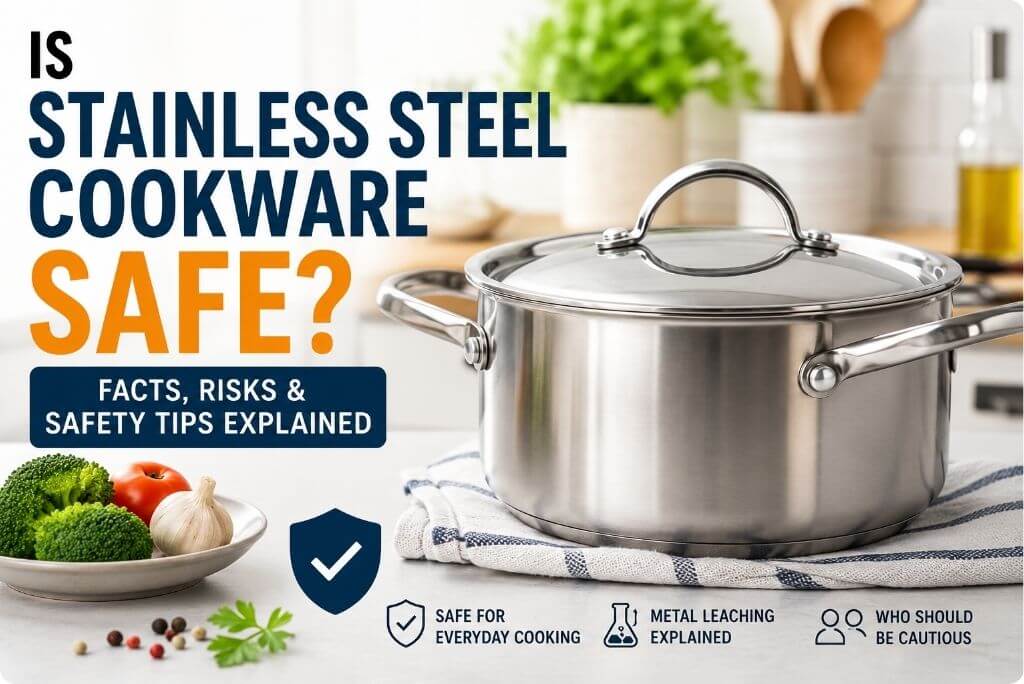
Stainless steel cookware is a popular choice for home kitchens because it is durable, versatile, and does not rely on a nonstick coating. But is stainless steel cookware safe for everyday cooking?
Yes, stainless steel cookware is generally considered safe for most people when used as intended. However, it can release small amounts of nickel and chromium into food under certain cooking conditions. The amount depends on factors such as the steel grade, cooking time, food acidity, and how often the cookware has been used.
For most home cooks, stainless steel remains a practical option for everyday meals. People with a known nickel allergy or dietary nickel sensitivity may need to take additional precautions.
This guide explains how stainless steel cookware is made, what research says about metal leaching, which grades are commonly used, and what to consider before buying a stainless steel pan.
Quick Answer: Is Stainless Steel Cookware Safe?
Yes. Food-contact stainless steel cookware is generally suitable for everyday cooking for most people.
Here are the main points to know:
- Stainless steel is resistant to rust and corrosion because of a protective surface layer.
- Some stainless steel cookware contains nickel and chromium, which can migrate into food in small amounts.
- Metal release can increase when acidic foods are cooked for long periods, particularly in new cookware.
- People with significant nickel sensitivity may need to consider their cookware choices more carefully.
- Stainless steel does not rely on a traditional nonstick coating, but it still requires proper use and maintenance.
The most important factors are the cookware’s material, condition, and intended use—not simply its price or appearance.
What Is Stainless Steel Cookware?
Stainless steel cookware is made from an iron-based alloy containing chromium and, depending on the grade, nickel and other elements.
These metals give stainless steel its strength and resistance to corrosion.
Chromium helps form a thin, protective oxide layer on the surface. This layer reduces the likelihood of rust and helps protect the underlying metal during normal use.
Nickel is added to many stainless steel grades to improve corrosion resistance and other material properties. Some grades also contain molybdenum, which can improve resistance to certain types of corrosion.

Stainless steel cookware is commonly used for:
- Frying and sautéing
- Searing meat
- Boiling pasta and vegetables
- Preparing soups and sauces
- Everyday stovetop cooking
Many stainless steel pans use a layered construction, with an aluminum or copper core between stainless steel layers. These internal layers help distribute heat more evenly.
The cooking surface, however, is usually stainless steel.
Why Is Stainless Steel Cookware Considered Safe?
Stainless steel is widely used in food preparation because it is durable and resistant to corrosion.
Its protective surface layer helps reduce direct interaction between the underlying metal and food.
Unlike conventional coated nonstick cookware, uncoated stainless steel does not depend on a separate nonstick layer that can wear away during use.
However, stainless steel is not completely non-reactive under every cooking condition.
Small amounts of metals such as nickel and chromium can migrate into food. The amount varies depending on the cookware and how it is used.
This does not automatically mean that stainless steel cookware is unsafe. The important question is how much metal is released and whether that amount could be a concern for a particular person.
For most people, properly manufactured stainless steel cookware is a practical choice for everyday cooking.
Does Stainless Steel Cookware Leach Nickel and Chromium Into Food?
Yes. Research has shown that stainless steel cookware can release small amounts of nickel and chromium into food during cooking.
This process is called metal leaching. It occurs when small amounts of metals from the cookware migrate into the food.
Nickel and chromium are part of the alloy used to manufacture many stainless steel products.
A 2013 study published in the Journal of Agricultural and Food Chemistry examined how stainless steel grade, cooking time, and repeated use affected nickel and chromium release into tomato sauce.
The researchers found that metal release varied with the steel grade and cooking conditions. New cookware released more metal in the tested conditions, and release generally declined with repeated cooking cycles.
The study also found that longer cooking times increased metal concentrations in the tomato sauce.
These findings show that metal release can occur, but the results from a particular experiment should not be treated as a measurement of every stainless steel pan or every cooking situation.
What Factors Affect Metal Leaching?
Several factors can influence how much nickel and chromium migrate from stainless steel into food.
1. Cooking time
Longer contact between food and cookware can increase metal release under some conditions.
This is particularly relevant when preparing acidic foods that simmer for extended periods.
2. Food acidity
Acidic ingredients such as tomatoes, vinegar, and citrus can influence metal release.
The effect depends on the food’s composition, the cookware’s surface, and the cooking conditions.
3. Cookware grade
Different stainless steel grades have different compositions and corrosion-resistance properties.
These differences can affect metal release.
4. New versus previously used cookware
Some studies have found higher metal release from new cookware than from previously used cookware under the tested conditions.
However, repeated use does not guarantee that metal release becomes zero.
5. Cookware condition
The surface condition and manufacturing quality can affect corrosion resistance.
If a pan develops deep corrosion, pitting, or other significant damage, it is worth reviewing the manufacturer’s care instructions and considering replacement.
Is Stainless Steel Cookware Safe for Everyday Cooking?
For most people, stainless steel cookware is suitable for everyday cooking.
It can be used for a wide range of meals, including:
- Eggs and vegetables
- Chicken and other meats
- Rice and pasta
- Soups and stews
- Sauces and sautéed dishes
Stainless steel is especially useful for cooking techniques that involve browning food or developing flavor through the browned bits left in the pan.
However, stainless steel can take some practice to use well.
Food may stick if the pan is too cool, if the cooking surface is not properly prepared, or if the food is moved before it has developed a browned surface.
Using appropriate heat and enough cooking fat when needed can make stainless steel easier to use.
For most home cooks, there is no need to avoid stainless steel simply because it contains nickel or chromium.
People with known nickel sensitivity should consider their individual circumstances.
Is Stainless Steel Cookware Safe for Acidic Foods?
Stainless steel is generally suitable for cooking acidic foods during normal meal preparation.
Common examples include:
- Tomato sauce
- Lemon-based sauces
- Vinegar-based dishes
- Wine-based sauces
- Tamarind-based recipes
However, acidic foods can increase metal release under certain conditions.
Research has found that metal migration can increase with longer cooking times and more acidic food environments.
For everyday cooking, preparing a tomato sauce or a vinegar-based dish in stainless steel is generally considered reasonable for most people.
If you regularly prepare highly acidic foods that simmer for many hours, you may want to consider the cooking time and your personal sensitivity to nickel.
Can You Store Acidic Food in Stainless Steel Cookware?
Stainless steel is generally resistant to corrosion, but cookware is not always the best long-term storage container for acidic leftovers.
A practical approach is to transfer leftovers to a suitable food-storage container after cooking.
This also makes it easier to refrigerate and organize food safely.
Avoid leaving food at room temperature for extended periods.
Is Stainless Steel Cookware Safe for People With Nickel Allergies?
This is an important consideration for people who have a known nickel allergy or dietary nickel sensitivity.
Many stainless steel cookware grades contain nickel.
Although the amount released during cooking is often small, the actual exposure can vary.
A 2016 study examined nickel and chromium release from stainless steel pots under common cooking conditions. The researchers found that release varied with factors such as food acidity, cooking time, and whether the cookware was new or previously used.
The study concluded that the tested cookware was generally suitable under the studied conditions, while noting that highly sensitive individuals could still experience problems.
What Should People With Nickel Sensitivity Consider?
If you have a known nickel allergy or have been advised to follow a low-nickel diet, consider the following:
- Check the cookware’s material specifications before buying.
- Ask the manufacturer about the grade of stainless steel used for the food-contact surface.
- Consider cookware made from materials that do not contain nickel in the food-contact surface.
- Discuss dietary nickel exposure with a qualified healthcare professional if you have a medically diagnosed sensitivity.
Not everyone with a skin nickel allergy will experience symptoms from eating food prepared in stainless steel cookware.
However, people with significant dietary nickel sensitivity may need individualized advice.
Which Stainless Steel Grades Are Commonly Used in Cookware?
Stainless steel cookware is often described using terms such as 18/10, 18/8, 18/0, 304, and 316.
These labels refer to different aspects of the material’s composition and classification.
Understanding them can help you evaluate cookware specifications.
304 Stainless Steel
Grade 304 is a common austenitic stainless steel.
It typically contains approximately 18% chromium and 8% nickel, although the exact composition depends on the applicable specification.
It offers good corrosion resistance and is widely used in food-contact applications.
18/8 Stainless Steel
The term 18/8 generally refers to stainless steel containing approximately 18% chromium and 8% nickel.
It is commonly associated with 304 stainless steel.
However, the label alone does not establish every detail of the alloy’s composition.
18/10 Stainless Steel
The term 18/10 generally refers to approximately 18% chromium and 10% nickel.
It is commonly used in cookware and kitchenware marketing.
The designation does not automatically mean that the cookware is safer or performs better than every product labeled 18/8.
18/0 Stainless Steel
The term 18/0 generally refers to stainless steel containing approximately 18% chromium and little or no nickel.
It is often associated with ferritic stainless steel grades such as 430.
These materials are commonly magnetic.
However, 18/0 is not a guarantee of absolutely zero nickel in every product.
If nickel avoidance is important for medical reasons, check the manufacturer’s material specifications rather than relying only on the label.
316 Stainless Steel
Grade 316 is a stainless steel grade that contains molybdenum in addition to chromium and nickel.
The molybdenum improves resistance to certain forms of corrosion.
However, 316 stainless steel is not automatically safer for everyone than 304 stainless steel.
Its suitability depends on the intended application and the individual’s needs.
Stainless Steel Grades at a Glance
| Label | General Description | What to Know |
| 304 | Austenitic stainless steel | Commonly used in food-contact applications |
| 18/8 | Approximate chromium and nickel content | Often associated with 304 |
| 18/10 | Approximate chromium and nickel content | Common cookware and kitchenware label |
| 18/0 | Low-nickel stainless steel designation | Often associated with magnetic ferritic grades |
| 316 | Molybdenum-containing stainless steel | Offers enhanced resistance to certain types of corrosion |
Important: These labels describe material composition or grade, not a universal safety ranking.
For cookware, the quality of manufacturing, food-contact surface, and intended use also matter.
Is Cheap Stainless Steel Cookware Safe?
A lower price does not automatically mean that stainless steel cookware is unsafe.
Budget-friendly cookware can be suitable for everyday cooking if it is made from appropriate food-contact materials and manufactured to a suitable standard.
The main differences between budget and premium cookware often involve construction, heat distribution, durability, and design.
For example, a thin stainless steel pan may develop hot spots more easily than a well-designed multilayer pan.
This can affect cooking performance without necessarily making the cookware unsafe.
What Should You Check Before Buying?
When choosing stainless steel cookware, consider:
- Whether the manufacturer identifies the food-contact material.
- Whether the cookware is suitable for your stovetop.
- Whether the handles and base are securely constructed.
- Whether the manufacturer provides clear care instructions.
- Whether the product has a suitable warranty and customer support.
Do not assume that a higher price guarantees greater safety.
A well-made, appropriately specified stainless steel pan can be a practical choice at different price points.
Benefits of Stainless Steel Cookware
Stainless steel has several practical advantages for everyday cooking.
Durability
Quality stainless steel cookware can last for many years with appropriate care.
It is generally resistant to everyday wear and does not depend on a conventional nonstick coating.
Versatility
Stainless steel can be used for frying, sautéing, boiling, and preparing sauces.
Its suitability for oven use depends on the cookware’s construction, handles, and manufacturer’s instructions.
No Conventional Nonstick Coating
Uncoated stainless steel does not rely on a separate nonstick coating.
This makes it useful for people who prefer a cooking surface without a conventional nonstick layer.
Easy Maintenance
Most stainless steel cookware can be cleaned with ordinary dish soap and water.
Some products are dishwasher-safe, but you should check the manufacturer’s instructions.
Long-Term Use
Because stainless steel cookware is durable, it may be used for many years rather than replaced frequently.
Its actual lifespan depends on the quality of construction and how it is maintained.
Potential Drawbacks of Stainless Steel Cookware
Stainless steel is useful, but it is not perfect for every kitchen.
Food Can Stick
Stainless steel does not have the same release properties as a nonstick cooking surface.
Eggs, fish, and other delicate foods may stick if the pan is not used properly.
Learning Curve
Some home cooks need time to learn how to control heat and prevent food from sticking.
Weight
Some multilayer stainless steel pans can be relatively heavy.
The weight depends on the size and construction.
Nickel Content
Many stainless steel grades contain nickel.
This may be relevant for people with significant nickel sensitivity.
Price Differences
Premium stainless steel cookware can be expensive, especially when it uses multilayer construction.
However, expensive cookware is not automatically safer.
How to Use Stainless Steel Cookware Properly
Using stainless steel correctly can improve cooking performance and help maintain the cookware.
1. Wash Before First Use
Wash the pan with warm water and dish soap before using it for the first time.
Follow any additional preparation instructions provided by the manufacturer.
2. Preheat the Pan Gradually
Heat the pan over an appropriate level of heat.
Avoid leaving an empty pan over very high heat for an extended period.
Excessive heat can cause discoloration, damage, or other problems depending on the cookware’s construction.
3. Use Cooking Oil When Needed
For foods that tend to stick, use an appropriate amount of cooking oil or another suitable cooking fat.
The amount depends on the recipe and the food being prepared.
4. Avoid Excessive Heat
Stainless steel can handle a wide range of cooking temperatures, but that does not mean every pan should be used at maximum heat.
Use the temperature recommended for the recipe and the cookware.
5. Clean After Cooking
Allow the pan to cool to a safe temperature before cleaning.
Avoid exposing a very hot pan to cold water, as sudden temperature changes can cause warping.
Use a suitable cleaning method for the type of residue.
6. Store Cookware Properly
Store the pan in a dry place.
If you stack multiple pans, use suitable protection to reduce unnecessary scratching.
How to Choose Stainless Steel Cookware
Choosing stainless steel cookware is easier when you focus on your actual cooking needs.
Check the Food-Contact Surface
Look for clear information about the material used on the cooking surface.
If nickel sensitivity is a concern, confirm the composition with the manufacturer.
Consider the Construction
Fully clad cookware generally has layers extending through the body of the pan.
Other designs may use a layered base.
These construction differences affect heat distribution and cooking performance.
Check Stovetop Compatibility
If you use an induction cooktop, confirm that the cookware is induction-compatible.
Not all stainless steel cookware works with induction.
Consider Weight and Handle Design
A comfortable handle and manageable weight can make everyday cooking easier.
This is particularly important if you frequently lift full pots or pans.
Review the Manufacturer’s Instructions
Check the manufacturer’s guidance for oven use, cleaning, temperature limits, and maintenance.
These instructions are more useful than relying on a general claim that all stainless steel cookware is the same.
Common Myths About Stainless Steel Cookware
Myth 1: Stainless Steel Never Releases Metals
Fact: Stainless steel can release small amounts of nickel and chromium into food under certain conditions.
The amount varies with the cookware and cooking method.
Myth 2: All Stainless Steel Cookware Contains the Same Amount of Nickel
Fact: Stainless steel grades have different compositions.
Some common grades contain nickel, while others contain little or none.
Myth 3: Expensive Stainless Steel Cookware Is Always Safer
Fact: Price alone does not establish safety.
Material specifications, manufacturing quality, and intended use are more relevant.
Myth 4: Stainless Steel Is Completely Non-Reactive
Fact: Stainless steel is corrosion-resistant, but metal release can occur under certain conditions.
Myth 5: Stainless Steel Cookware Is Unsafe for Everyone With a Nickel Allergy
Fact: Individual sensitivity varies.
People with significant dietary nickel sensitivity should consider their own circumstances and seek professional guidance when needed.
Frequently Asked Questions
Is stainless steel cookware safe for everyday cooking?
Yes. Stainless steel cookware is generally considered suitable for everyday cooking for most people when used as intended.
Does stainless steel cookware release nickel?
Yes. Some stainless steel cookware can release small amounts of nickel into food. The amount depends on factors such as the material grade, food acidity, cooking time, and previous use.
Can I cook tomato sauce in stainless steel?
Yes. Stainless steel is generally suitable for cooking tomato sauce during normal meal preparation. However, prolonged cooking of acidic foods can increase metal release under certain conditions.
Is 18/10 stainless steel safe for cooking?
18/10 stainless steel is commonly used in cookware and kitchenware. It is generally suitable for food-contact applications, but the label alone does not establish the safety or quality of every product.
Is 18/0 stainless steel better for people with nickel sensitivity?
18/0 stainless steel generally contains little or no nickel and may be worth considering for people who want to reduce nickel exposure.
However, the label does not guarantee zero nickel. People with significant sensitivity should verify the material specifications.
Is scratched stainless steel cookware safe?
Minor surface scratches are common and do not automatically make stainless steel cookware unsafe.
However, deep pitting, severe corrosion, or significant damage should be evaluated according to the manufacturer’s care guidance.
Can stainless steel cookware go in the dishwasher?
Some stainless steel cookware is dishwasher-safe, but not all products are designed for dishwasher cleaning.
Check the manufacturer’s instructions before placing cookware in the dishwasher.
How long does stainless steel cookware last?
Quality stainless steel cookware can last for many years with proper care.
Its lifespan depends on construction, usage, and maintenance.
Final Verdict: Is Stainless Steel Cookware Safe?
Yes. Stainless steel cookware is generally a practical and suitable choice for everyday cooking for most people.
It is durable, versatile, and does not rely on a conventional nonstick coating.
However, stainless steel can release small amounts of nickel and chromium into food under certain conditions. This is particularly relevant when cooking acidic foods for extended periods or when using new cookware.
For most home cooks, there is no need to avoid stainless steel simply because it contains these metals.
People with a known nickel allergy or dietary nickel sensitivity should consider the cookware’s material specifications and seek individualized advice when necessary.
When choosing a pan, focus on its food-contact material, construction, compatibility with your stovetop, and the manufacturer’s care instructions.
A well-made stainless steel pan can be a dependable part of an everyday kitchen.
References
The following research sources support the discussion of nickel and chromium release from stainless steel cookware.
- Stainless Steel Leaches Nickel and Chromium Into Foods During Cooking — Journal of Agricultural and Food Chemistry
- Release of Nickel and Chromium in Common Foods During Cooking in Stainless Steel Pots — PubMed
- Cutlery Stainless Steel Grades: 18/8, 18/10 and 18/0 — British Stainless Steel Association