Is Carote Cookware Safe? An Honest Review
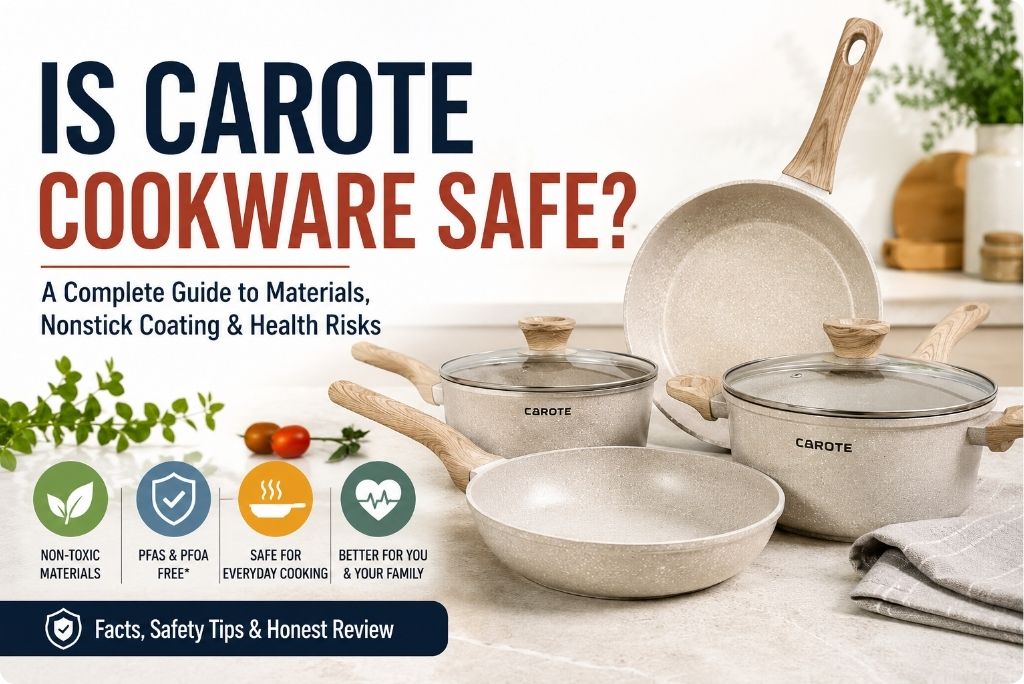
Is Carote cookware safe? In most cases, yes. Carote cookware is generally considered safe for everyday cooking when used correctly and cared for properly. However, many shoppers still have important questions about its nonstick coating, the materials it uses, and whether it contains chemicals like PFAS, PTFE, PFOA, lead, or cadmium.
With so much conflicting information online, it can be difficult to separate marketing claims from evidence-based facts. That’s why this guide takes a balanced, research-backed approach. We’ll explain what Carote cookware is made of, how its nonstick coating works, what current safety guidance says, and whether there are any health risks you should know about. We’ll also cover how to use Carote cookware safely, when it should be replaced, and how it compares with other popular nonstick cookware brands.
By the end of this article, you’ll have a clear understanding of whether Carote cookware is a safe choice for your kitchen and whether it’s the right cookware for your cooking style and budget.
Is Carote Cookware Safe? (Quick Answer)
Yes, Carote cookware is generally safe for everyday cooking when it is used the right way and kept in good condition. It is made for regular home use, and many shoppers choose it because it is lightweight, easy to clean, and nonstick.
That said, no cookware is safe forever if it is badly worn or overheated. The coating, cooking temperature, and the overall condition of the pan all matter. If you use medium or low heat, avoid scratching the surface, and replace the pan when the coating starts to peel or wear out, Carote can be a practical and safe choice for many kitchens.
The main thing to remember is this: Carote is safe when it is used properly, but like any nonstick cookware, it needs basic care to stay that way.

What Is Carote Cookware Made Of?
Aluminum Core
Carote cookware is usually made with an aluminum base. Brands use aluminum because it heats up quickly and spreads heat well across the pan. That helps food cook more evenly, without hot spots in one area and cooler spots in another.
It is also lightweight, which makes the pans easier to lift, move, and clean. The tradeoff is that aluminum alone is not very durable for direct cooking, so it needs a coating on top to protect the surface.
Nonstick Coating
On top of the aluminum, Carote uses a nonstick coating that helps food slide off more easily. This is what makes the pans simple to use for eggs, pancakes, and other foods that usually stick.
The coating is the part that does the heavy lifting for cooking performance. It gives the pan its smooth surface, but it also means the cookware needs gentle care. If the coating gets scratched or worn down, the pan may not work as well over time.
Why These Materials Matter
The materials affect more than just how the pan cooks. They also affect safety, how long the cookware lasts, and how easy it is to maintain.
An aluminum body helps with fast, even heating. The nonstick coating makes cooking and cleanup easier. But because the coating can wear with time, Carote cookware is best for people who cook at moderate heat and take basic care of their pans.
Is Carote Cookware Non-Toxic?
In simple terms, “non-toxic” means the cookware is made without some of the chemicals people usually worry about in nonstick pans. Carote says many of its cookware lines are PTFE-free, PFOA-free, PFOS-free, lead-free, and cadmium-free. That is a good sign, but it is still worth checking the exact product page, because not every Carote pan is described the same way.
The chemical names can be confusing, but they do not all mean the same thing. PFAS is the big family name; PFOA and PFOS are two chemicals in that group. PTFE is different again, and it is the coating used in many nonstick pans. Lead and cadmium are separate materials, so they are not the same as PFAS.
The key point is this: Carote’s safety claim is mainly about what is not in the coating, while the FDA says some PFAS are approved for nonstick cookware and that these coatings are tightly bound to the pan, with negligible migration to food in normal use. So the real question is not just the label, but which Carote line you are buying and how you use it.
Does Carote Cookware Release Harmful Chemicals?
For normal everyday cooking, Carote cookware is not designed to release harmful chemicals into your food. Carote markets many of its pans as PTFE-, PFOA-, PFAS-, lead-, and cadmium-free, although the exact materials can vary by product line, so the specific listing matters.
FDA guidance says some PFAS are approved for use in nonstick cookware coatings, and those coatings are made by a heating process that tightly binds the polymer to the pan. The FDA also says studies show a negligible amount of PFAS can migrate to food from these coatings under normal use.
The main risk comes from overheating or using a pan that is badly worn. Once a coating is scratched, peeling, or overheated, it may not perform as well and should be treated with more caution. In other words, the pan is usually fine when used gently, but it should not be pushed past its limits.
Is Carote Cookware Safe at High Temperatures?
Carote cookware is best used on low to medium heat. The brand’s own care guide says nonstick cookware is not meant for high heat and advises against preheating an empty pan. In everyday cooking, that means it is better for gentle frying, sautéing, and eggs than for very hot searing.
The main problem with too much heat is that it can damage the coating over time. Once a nonstick pan gets too hot, it may lose its smooth surface, stop releasing food as easily, and wear out faster. Carote also warns that sudden temperature changes can warp the pan and damage the surface.
FDA guidance is reassuring for normal use: it says some PFAS are authorized for nonstick cookware coatings, and studies show only negligible migration to food under regular use. The safest approach is simple—cook at moderate heat, avoid empty-pan overheating, and replace the pan if the surface is badly worn.
What Happens If Carote Cookware Gets Scratched?
A small surface mark is not the same as a pan that is peeling or flaking. Light scratches are often just a sign of normal wear, but deep scratches can mean the coating is starting to break down. Carote’s own care guide says metal utensils and abrasive cleaning tools can scratch the surface, and food-safety guidance on nonstick pans says damaged coatings should be treated more carefully.
If the coating is still smooth and food is releasing normally, the pan may still be usable. But once you see peeling, chipping, or deep damage, it is safer to replace it rather than keep using it. That is the point where the surface is no longer in good condition and the pan is more likely to perform poorly over time.
| Condition | Safe to Continue Using? | Recommendation |
| Light surface marks | Usually yes | Keep using it, but avoid metal tools and rough cleaning. |
| Deep scratches | Not ideal | Watch closely and plan to replace if the damage grows. |
| Peeling or flaking coating | No | Replace the pan. |
| Food sticking more than usual | Maybe not for long | Check the surface carefully; worn coating may be failing. |
A simple rule works well here: if the damage is only cosmetic, the pan may still be fine; if the coating is lifting, breaking, or coming off, it is time for a new one.
Pros and Cons of Carote Cookware
Pros
- Generally safe for everyday cooking when used correctly.
- Excellent nonstick surface that releases food easily.
- Lightweight and comfortable to handle.
- Heats quickly and distributes heat evenly.
- Easy to clean with mild soap and a soft sponge.
- Affordable compared to many premium cookware brands.
Cons
- Not designed for high-heat cooking or searing.
- The nonstick coating can wear out over time.
- Requires gentle care to avoid scratches.
- May need replacing sooner than stainless steel or cast iron cookware.
Carote Cookware vs Other Nonstick Cookware
Carote is a solid choice if you want simple, low-fuss cookware and do not want to spend a lot. The catch is that Carote sells different lines, so the coating is not always the same across the brand. Some Carote products are marketed as PTFE-free and PFAS-free, while at least one official Carote PTFE page says a specific product contains PTFE. That means the exact set matters.
Compared with GreenPan, Carote is usually the more budget-friendly, everyday option. GreenPan leans harder into PFAS-free ceramic nonstick and says its Thermolon coating is made without PFAS, with strong focus on scratch resistance and even heating. In plain terms, GreenPan often feels more premium, while Carote is the simpler value pick.
Compared with Caraway, Carote is less expensive and more practical for shoppers who mainly want decent nonstick performance without paying for a premium brand. Caraway uses a proprietary ceramic non-stick coating and says it is made without PTFE, PFOA, PFAS, lead, and cadmium. Caraway looks more polished and is positioned as a higher-end option, but Carote usually makes more sense if value matters most.
Compared with T-fal, Carote is more of a lightweight home-kitchen choice, while T-fal offers a wider mix of ceramic and traditional nonstick options. T-fal says some of its cookware uses a durable ceramic nonstick interior and recycled aluminum body, and it also sells PTFE nonstick products in other categories. If you want lots of variety, T-fal is flexible; if you want a straightforward budget nonstick set, Carote is easier to pick.
For most buyers, the choice comes down to this: Carote for value, GreenPan for PFAS-free ceramic performance, Caraway for a premium ceramic option, and T-fal for broad selection and practical everyday use.
How to Use Carote Cookware Safely
Carote cookware can last much longer if you follow a few simple habits. Most nonstick pans do not need high heat to cook food well, so cooking on low to medium heat is usually the best choice. It protects the coating and helps the pan perform better over time.
Avoid heating an empty pan for several minutes before adding oil or food. Empty cookware can become much hotter than expected, which may shorten the life of the nonstick surface.
Use silicone, wooden, or nylon utensils instead of metal ones. These softer materials are much less likely to scratch the coating during everyday cooking.
After cooking, let the pan cool before washing it. Clean it with warm, soapy water and a soft sponge. Skip steel wool, scouring pads, and harsh cleaners because they can wear down the nonstick surface.
When storing your cookware, avoid stacking pans directly on top of each other. If you need to stack them, place a soft pan protector, towel, or cloth between each pan to help prevent scratches.
These simple habits only take a little extra effort, but they can help keep your Carote cookware cooking well and looking good for years.
When Should You Replace Carote Cookware?
Nonstick cookware does not last forever, and Carote is no exception. With proper care, it can serve you well for years, but there comes a point when replacing it is the safer and more practical choice.
Replace your Carote cookware if you notice any of these signs:
| Sign | Why It Matters |
| Peeling or flaking coating | A damaged coating can affect cooking performance and should not be used. |
| Deep scratches exposing the metal | The protective cooking surface is no longer intact, and the pan may not perform as intended. |
| Warped bottom | The pan may no longer heat evenly or sit flat on the stovetop. |
| Food sticks even after proper cleaning | This usually means the nonstick coating has worn out. |
| Loose or damaged handles | A loose handle can make lifting or pouring hot food unsafe. |
A few light scratches or slight discoloration are usually part of normal wear and are not always a reason to throw the pan away. Focus on changes that affect how the cookware performs or its overall condition.
If you’re unsure, a simple rule is to ask yourself whether the pan still cooks evenly, releases food easily, and feels safe to handle. If the answer is no, replacing it is often the best decision.
Read More: Is Cuisinart Stainless Steel Cookware Safe?
Frequently Asked Questions
Is Carote cookware safe for everyday cooking?
Yes. Carote cookware is generally safe for daily use when you follow the care instructions. Cooking on low to medium heat and keeping the coating in good condition will help it perform safely and last longer.
Does Carote cookware contain PFAS or PFOA?
It depends on the product line. Many of Carote’s newer cookware collections are advertised as free from PFAS, PFOA, lead, and cadmium, while some other products may use different coating technologies. Always check the product description before buying to confirm the materials used.
Is Carote cookware oven-safe?
Some Carote cookware is oven-safe, while other pieces are not. The temperature limit can also vary between product lines, especially for cookware with detachable handles or glass lids. Always follow the manufacturer’s instructions for your specific pan.
Can Carote cookware be used on induction cooktops?
Many Carote cookware sets work on induction cooktops, but not every model does. If you have an induction stove, look for “induction compatible” in the product specifications before purchasing.
How long does Carote cookware last?
There is no fixed lifespan because it depends on how often you cook and how well you care for the pan. With proper use and gentle cleaning, many people can expect several years of regular use before the nonstick coating begins to wear.
Is Carote cookware worth buying?
For many home cooks, yes. Carote offers lightweight, easy-to-clean cookware at an affordable price. If you mainly cook on low to medium heat and take good care of the coating, it offers good value for the money. If you regularly cook at very high temperatures or want cookware that lasts for decades, stainless steel or cast iron may be a better investment.
Final Verdict
Carote cookware is a good choice for home cooks who want lightweight, easy-to-use, and affordable nonstick cookware. It works especially well for everyday meals like eggs, vegetables, pancakes, and other foods that benefit from a nonstick surface.
Its biggest strengths are its even heating, simple cleanup, and budget-friendly price. The main limitation is that the nonstick coating requires gentle care. Like any coated cookware, it is not the best option for high-heat cooking or rough handling, and the coating will eventually wear with regular use.
Overall, Carote cookware offers good value for most households. If you cook mainly on low to medium heat, use non-metal utensils, and replace the pan when the coating becomes damaged, it can be a safe and practical addition to your kitchen. If your cooking style involves frequent high-heat searing or you want cookware that can last for decades, stainless steel or cast iron may be a better long-term investment.