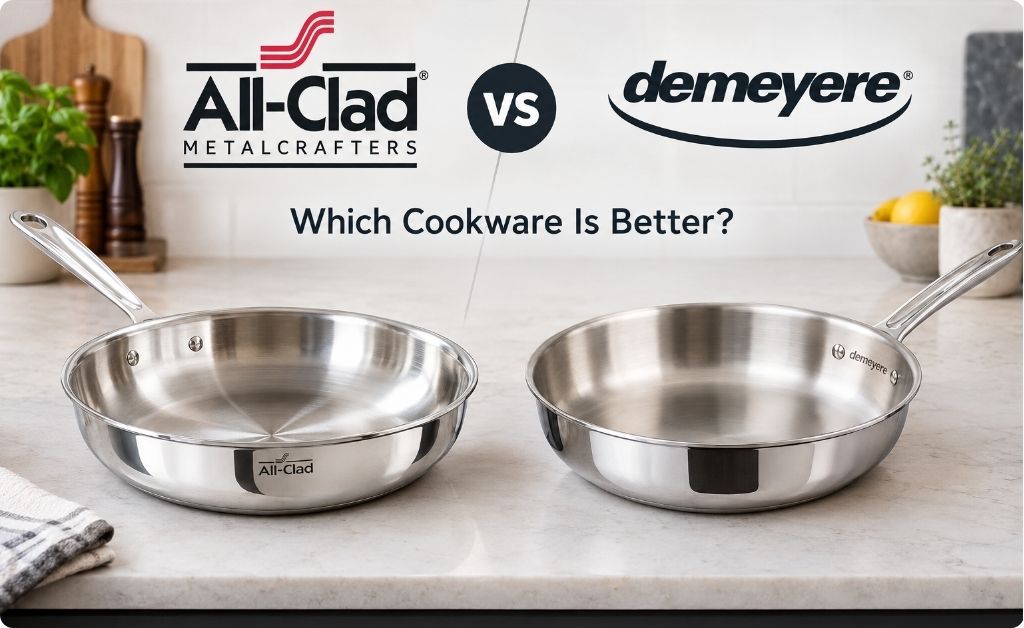
All-Clad vs Demeyere: Which Cookware Is Better?
If you’re shopping for premium stainless-steel cookware, All-Clad and Demeyere are two names that quickly come up. Both brands make high-end cookware designed to last for years, but they take somewhat different approaches to construction, heat management, handling, and design.
So, which is better: All-Clad or Demeyere?
There isn’t one answer for everyone. All-Clad is an excellent choice if you want responsive, fully clad cookware that is relatively easy to handle. Demeyere is especially appealing if you value strong heat retention, heavy construction, induction performance, and features such as welded handles and Silvinox-treated stainless steel.
The bigger point is that you shouldn’t compare the brands only by the number of layers. The specific cookware collection matters just as much. An All-Clad D3, D5, or Copper Core pan can behave differently, just as Demeyere Industry and Atlantis cookware are designed around different priorities.
This guide breaks down those differences so you can choose based on how you actually cook, rather than simply buying the more expensive pan.
Quick Answer: All-Clad vs Demeyere
Choose All-Clad if you want excellent stainless-steel performance, fast temperature response, easier handling, and a more traditional fully clad design.
Choose Demeyere if you want heavier cookware with strong heat retention, excellent induction-focused design, welded handles, and easy-to-clean stainless-steel surfaces.
For most home cooks, All-Clad D3 is already more than capable of handling everyday cooking. You don’t need to spend significantly more on Demeyere simply because it has more layers or costs more.
On the other hand, Demeyere makes a lot of sense if you regularly sear meat, cook on induction, prefer substantial cookware, or specifically want features such as rivet-free interiors and a very stable cooking surface.
And there’s an important detail: more layers do not automatically mean better cookware. More material can increase heat retention and durability, but it can also add weight and change how quickly a pan responds to temperature adjustments. Independent testing has found meaningful differences in heating and heat retention between individual All-Clad and Demeyere collections, which is why brand-level comparisons can be misleading.
All-Clad vs Demeyere at a Glance
| Feature | All-Clad | Demeyere |
| Main strength | Balanced performance and responsiveness | Heat retention and heavy-duty construction |
| Typical construction | 3-ply to 5-ply, depending on collection | 5-ply and 7-ply options, depending on collection |
| Core materials | Aluminum, copper, or graphite depending on collection | Primarily aluminum, with specialized technologies in higher-end lines |
| Heat response | Generally very responsive | Generally slower but excellent at holding heat |
| Heat retention | Very good | Excellent in heavier collections |
| Induction | Compatible with major stainless collections | Strong focus on induction performance |
| Handles | Riveted | Many collections use welded handles |
| Cooking surface | Stainless steel | Stainless steel |
| Cleaning | Straightforward, but rivets can collect residue | Rivet-free interiors are easier to clean |
| Weight | Moderate to heavy | Often heavier |
| Best for | Versatile everyday cooking | Searing, induction, heat retention, premium features |
| Made in | U.S. for major clad collections | Belgium for many major collections |
The exact specifications vary by collection, so this table should be treated as a general comparison rather than a substitute for checking the individual pan you’re considering. All-Clad’s current collection information, for example, lists D3 as 3-ply aluminum-core cookware, D5 as 5-ply, Copper Core as 5-ply with copper, and G5 as 5-ply with graphite.
Demeyere Industry 5, meanwhile, uses 5-ply construction with a thick aluminum core, while the brand’s higher-end lines use different construction approaches.
All-Clad vs Demeyere: What’s Actually Different?
The most useful way to compare these brands is to look beyond the marketing terms and understand how the cookware is built.
Construction
All-Clad is well known for fully bonded cookware. Its stainless-steel collections use multiple layers of metal bonded together, with the number and type of layers changing between collections.
For example, All-Clad D3 uses three layers with an aluminum core, while D5 uses five layers. Copper Core adds copper to the construction for greater heat responsiveness.
This gives shoppers several performance levels without requiring them to leave the All-Clad lineup.
Demeyere also uses multi-layer construction, but its approach can be more focused on thickness, thermal mass, induction performance, and specialized technologies.
Demeyere Industry 5, for example, uses five layers from rim to rim with a thick aluminum core. The company says this construction is designed for even heating and heat retention.
This leads to an important lesson:
Don’t assume that a 7-ply pan is automatically better than a 3-ply pan.
The layers are only part of the story. What those layers are made from, how thick they are, where they’re positioned, and how much total material the pan contains all affect how it cooks.
Why this matters in the kitchen
Imagine you’re making a quick pan sauce.
You increase the heat to reduce the sauce, then lower it because the sauce is getting too hot.
A more responsive pan can react relatively quickly to that adjustment.
Now imagine you’re searing several cold steaks.
A heavier pan with greater thermal mass can have an advantage because it loses less heat when you add a large amount of cold food.
Neither behavior is automatically better.
They are useful for different cooking situations.
Heat Distribution
Heat distribution is one of the biggest reasons people buy premium stainless-steel cookware.
Stainless steel itself isn’t an especially good heat conductor. That’s why quality clad cookware uses more conductive metals inside the stainless-steel layers.
All-Clad commonly uses aluminum or copper depending on the collection. Its Copper Core line, for example, combines copper with aluminum and stainless steel to provide faster heat distribution and temperature control.
Demeyere Industry 5 uses a thick aluminum core throughout the pan. The manufacturer specifically describes its 5-ply construction as providing even heat distribution and retention.
In practical terms, good heat distribution helps reduce extreme hot spots.
That’s useful when you’re:
- Browning meat
- Sautéing vegetables
- Making pancakes
- Cooking sauces
- Frying foods across a large cooking surface
Independent side-by-side testing of several All-Clad and Demeyere collections found that both brands could heat quite evenly, but the speed at which they reached cooking temperature differed considerably between collections.
So rather than asking:
“Which brand distributes heat better?”
A better question is:
“Which specific collection gives me the heating behavior I want?”
Heat Retention
Heat retention is where Demeyere’s heavier cookware becomes especially interesting.
A pan with greater thermal mass can store more heat. That can be useful when you add a large amount of cold food because the pan may recover and maintain its temperature more effectively.
This is one reason heavy cookware is popular for:
- Steak
- Burgers
- Chicken
- Shallow frying
- Browning
- Long simmering
Independent testing found that Demeyere Atlantis retained heat particularly well compared with several All-Clad collections tested alongside it.
But there is a trade-off.
A heavier pan generally takes longer to heat and can take longer to cool.
That’s not necessarily a problem. In fact, it can be an advantage when you want stable temperatures.
But if you’re someone who frequently moves between high and low heat, a more responsive pan may feel easier to control.
Heat retention vs responsiveness
Think of the difference this way:
Responsive cookware:
“Change the burner, and the pan changes relatively quickly.”
High-thermal-mass cookware:
“Get the pan hot, and it stays hot for longer.”
Good cooks can work with either. The better choice depends on your cooking habits.
Cooking Performance
This is ultimately where premium cookware needs to justify its price.
A pan can have impressive construction on paper, but if it doesn’t make cooking easier or more consistent, those specifications don’t mean much.
Searing Steak and Meat
Both brands are capable of excellent searing.
The key is not simply the brand. You also need to preheat the pan properly, use enough cooking fat, and avoid overcrowding.
Demeyere’s heavier constructions can be particularly attractive for searing because their thermal mass helps the pan maintain heat when cold food is added.
This is especially useful if you’re cooking several pieces of meat at once.
All-Clad can also produce excellent browning, while its somewhat lighter construction can make the pan easier to move around the stove.
For maximum heat retention, I’d lean toward heavier Demeyere collections.
For a balance of searing performance and easier handling, All-Clad is hard to fault.
Cooking Eggs and Delicate Foods
Stainless steel is not naturally nonstick, regardless of whether the pan costs $100 or $500.
Eggs can stick badly if the pan is too cold, too hot, or not properly prepared.
For delicate foods, temperature control becomes more important than simply buying the thickest pan available.
All-Clad’s more responsive collections can be appealing here because they allow relatively quick changes in cooking temperature.
Demeyere can also perform very well, but heavier cookware may require a little more patience during preheating and temperature adjustments.
If you’re new to stainless steel, don’t judge the cookware based on your first scrambled egg.
Learning temperature control is part of learning stainless-steel cooking.
Sauces and Pan Reductions
This is one area where responsiveness matters.
When reducing a sauce, you may need to move quickly from high heat to medium or low heat.
A highly responsive pan can make those adjustments easier.
All-Clad offers several constructions aimed at different levels of temperature response. Its Copper Core collection, for example, uses a copper center specifically for rapid heat distribution and precise control.
Demeyere’s heavier pans are excellent when you want stable heat, but they may not feel as quick to respond as a lighter construction.
For delicate sauces and cooks who frequently adjust heat, All-Clad Copper Core is particularly interesting.
For cooks who prefer steady, stable heat, Demeyere can be an excellent fit.
High-Heat Cooking
Both brands can handle high-heat cooking when used according to their manufacturer’s instructions.
But remember that high heat doesn’t automatically produce better food.
For most home cooking, medium to medium-high heat is enough for many stainless-steel tasks.
Using excessive heat can increase:
- Discoloration
- Burnt oil
- Sticking
- Difficult cleanup
The better goal is controlled heat, not maximum heat.
Induction Cooking
If you cook on induction, this comparison becomes even more interesting.
Both brands offer induction-compatible cookware.
All-Clad’s major stainless collections such as D3, D5, Copper Core, and G5 are listed as induction compatible.
Demeyere puts a particularly strong emphasis on induction performance. Its Industry 5 cookware uses a flat-base design and specialized construction intended for induction cooking. The manufacturer also claims improved induction efficiency compared with conventional cookware.
This doesn’t mean every Demeyere pan will magically cook food better on every induction cooktop.
Your cooktop itself matters too.
Still, if you’re buying specifically for induction and want a heavy, stable pan, Demeyere deserves serious consideration.
All-Clad vs Demeyere Weight and Handling
This is one of the most important differences that buyers often overlook.
Premium cookware isn’t automatically better simply because it’s heavier.
A heavy pan can feel stable and substantial, but it can also become tiring when you’re cooking every day.
Independent testing has found substantial weight differences between some comparable All-Clad and Demeyere pans. For example, Prudent Reviews reported that a Demeyere Atlantis Proline 11-inch fry pan weighed considerably more than a larger All-Clad D3 fry pan.
That difference is noticeable when you:
- Lift the pan
- Pour from it
- Move it between burners
- Toss vegetables
- Drain cooking liquid
- Wash it in the sink
If you have no problem lifting heavy cookware, this may not bother you.
But if you prefer cookware that feels agile, All-Clad may be the more comfortable choice.
Handle design
All-Clad generally uses riveted stainless-steel handles. Its current collection information describes the handles as designed around a chef’s underhand grip.
Demeyere Industry uses welded stainless-steel handles, eliminating interior rivets. The manufacturer says this makes the cooking surface easier to clean and more hygienic.
This is more than a cosmetic difference.
If you’ve ever tried to scrub grease and burnt food from around cookware rivets, you’ll understand why a smooth interior can be attractive.

Which All-Clad Collection Should You Compare?
It’s easy to make a mistake here.
Someone might say:
“Demeyere is better than All-Clad.”
But which All-Clad?
D3 and D5 are not identical.
Copper Core isn’t identical to either.
All-Clad’s current collection information lists:
- D3 Stainless: 3-ply aluminum core
- D5 Stainless: 5-ply stainless-steel and aluminum construction
- Copper Core: 5-ply construction with copper
- G5 Graphite: 5-ply construction using graphite, aluminum, and stainless steel
All-Clad D3
For most home cooks, D3 is the logical starting point.
It’s simpler than the more expensive constructions, responsive, fully clad, and capable of handling almost everything you would reasonably ask of stainless cookware.
If you’re buying your first premium stainless-steel pan, D3 is difficult to ignore.
All-Clad D5
D5 adds more layers and is designed around greater stability and temperature control.
It’s worth considering if you like the feel of heavier cookware and don’t mind paying more.
But don’t assume D5 will automatically transform your cooking.
For many home cooks, the practical difference between good D3 and D5 cooking may be much smaller than the price difference suggests.
All-Clad Copper Core
Copper Core is more specialized.
Copper conducts heat very efficiently, so this collection is particularly appealing if you value rapid temperature response and precise control.
It’s especially interesting for cooks who regularly make:
- Sauces
- Reductions
- Custards
- Delicate dishes
- Recipes where temperature changes happen frequently
All-Clad describes Copper Core as combining copper’s responsiveness with stainless steel’s durability.

Which Demeyere Collection Should You Compare?
The same principle applies to Demeyere.
You shouldn’t compare All-Clad D3 against an expensive Demeyere collection and then conclude that one entire brand is superior.
Demeyere Industry 5
Industry 5 is one of the most useful Demeyere collections to compare with All-Clad D5 and other premium clad cookware.
It uses five-ply construction with a thick aluminum core and is designed for strong heat conduction and retention.
Industry 5 also includes several features that distinguish it from traditional All-Clad designs:
- Welded handles
- No interior rivets
- Silvinox surface treatment
- Flat-base technology
- Induction-focused construction
The 9.5-inch Industry fry pan, for example, is listed as induction compatible, dishwasher safe, oven and broiler safe to 500°F, and backed by a lifetime warranty.
Demeyere Atlantis
Atlantis sits further toward the heavy, high-performance end of Demeyere’s range.
Its thick construction gives it substantial thermal mass.
That’s excellent if you want a pan that stays hot during demanding cooking.
But it’s also the kind of cookware where you should ask yourself:
Do I actually want a very heavy pan?
If the answer is no, spending more money on Atlantis may not make your cooking experience better.
All-Clad vs Demeyere: Cleaning and Maintenance
Both brands are relatively easy to maintain compared with cookware that requires seasoning or delicate coating care.
But there are some differences.
All-Clad’s riveted handles leave metal fasteners exposed inside the cooking surface. They don’t make the pan unsafe, but food and grease can collect around them.
Demeyere’s welded handles eliminate those interior rivets.
That creates a completely smooth cooking surface, which is particularly convenient when you’re cleaning after a sticky meal.
Demeyere also uses its Silvinox surface treatment on Industry cookware. The manufacturer says the treatment helps maintain the stainless-steel finish and resist fingerprints and certain staining.
How to clean either type
For normal cooking:
- Let the pan cool somewhat.
- Add warm water and a small amount of dish soap.
- Soak if food is stuck.
- Use a non-abrasive scrubber.
- For stubborn discoloration, use a stainless-steel cleaner designed for cookware.
Don’t rely on extreme heat to burn food off the pan.
And don’t assume that stainless steel needs to look perfect after every meal. Some discoloration is cosmetic and doesn’t mean the pan has stopped working properly.
Durability and Long-Term Value
Both brands make cookware intended for long-term use.
That’s one reason premium stainless steel can make sense.
A $250 pan may sound expensive compared with a $50 pan, but if the expensive pan remains useful for 15 or 20 years, the annual cost can become much more reasonable.
For example:
$300 pan ÷ 15 years = $20 per year
That doesn’t automatically make the $300 pan a better purchase. But it gives you a more useful way to think about the investment.
The real question is:
Will I use this pan often enough to justify the extra money?
If you cook several times a week, a premium skillet or sauté pan can earn its place.
If you rarely cook, buying an expensive cookware set may be unnecessary.
Don’t buy a huge set just because it looks like a better deal
This is one of the easiest ways to overspend.
You may use:
- One 10- or 12-inch skillet
- One saucepan
- One sauté pan
- One stockpot
far more often than the remaining pieces in a large set.
For many home cooks, buying a few excellent pieces individually makes more sense than buying an expensive 10-piece set.
Related Topic: Calphalon vs All-Clad Cookware
Which One Should You Buy?
At this point, the choice is less about which brand wins and more about what you want from your cookware.
Choose All-Clad if…
All-Clad is a strong choice if you want:
- Excellent everyday stainless-steel performance
- A more manageable weight
- Responsive temperature changes
- Traditional fully clad cookware
- Several collection options
- Strong all-around performance
- U.S.-made major clad collections
All-Clad’s D3 line is especially attractive for someone who wants premium cookware without jumping immediately into the most expensive construction.
Choose Demeyere if…
Demeyere is worth considering if you prioritize:
- Strong heat retention
- Heavy-duty cookware
- Induction performance
- Welded handles
- Rivet-free cooking surfaces
- Easy cleanup
- Belgian-made cookware
- A more substantial feel
Industry 5 is particularly interesting for people who want premium performance without going all the way toward the heaviest Demeyere construction.
Don’t overpay if…
You probably don’t need the most expensive cookware available if you mainly:
- Cook eggs and vegetables
- Make pasta
- Prepare simple sauces
- Cook occasional chicken
- Make basic weeknight meals
A well-used All-Clad D3 can be a better purchase than an expensive pan that spends most of its life sitting in the cabinet.
And if you’re still learning stainless-steel cooking, spending more money won’t automatically solve sticking problems.
Technique matters.
Related Topic: HexClad vs All-Clad
Final Verdict: All-Clad vs Demeyere
So, which is better: All-Clad or Demeyere?
For most home cooks, I’d give All-Clad the edge as the more balanced choice. Its major stainless collections offer excellent performance, good responsiveness, strong durability, and a range of constructions that make it easier to find a pan that fits your cooking style. All-Clad currently offers D3, D5, Copper Core, and G5 among its stainless options, giving buyers several different performance profiles.
But Demeyere can be the better choice for a specific type of cook.
If you want maximum heat retention, substantial cookware, strong induction-focused design, welded handles, and a rivet-free cooking surface, Demeyere deserves the extra consideration. Its Industry 5 line, for example, combines 5-ply construction with a thick aluminum core, welded handles, Silvinox treatment, and induction-focused design.
The most important lesson is this:
Don’t choose based on the brand name or number of layers alone. Choose based on how you cook.
For a first premium stainless-steel purchase, All-Clad D3 is the sensible starting point for many people.
For someone who wants heavier cookware and excellent heat retention, Demeyere Industry 5 is a compelling step up.
And for cooks who specifically want maximum thermal mass and don’t mind substantial weight, higher-end Demeyere collections such as Atlantis become much more interesting.
In other words, there is no need to crown one brand the universal winner. The better pan is the one whose heat response, weight, construction, and features match your kitchen.
Related Topic: HexClad vs Le Creuset Cookware
Frequently Asked Questions
Is Demeyere better than All-Clad?
Not universally. Demeyere has advantages in areas such as heat retention, heavy construction, induction-focused design, and welded handles. All-Clad offers excellent responsiveness, durability, maneuverability, and a broader range of stainless-steel constructions. The specific collection matters more than the brand name alone.
Is Demeyere worth the extra money?
It can be, but not for everyone. If you value heavy construction, heat retention, induction performance, and rivet-free interiors, the premium may be worthwhile. For basic everyday cooking, a less expensive All-Clad D3 may already provide more performance than you need.
Which is better for induction, All-Clad or Demeyere?
Both have induction-compatible stainless-steel collections. Demeyere puts particular emphasis on induction performance and flat-base stability, making it especially attractive to induction users.
Is All-Clad lighter than Demeyere?
Generally, yes, although the exact difference depends on the collections and pan sizes being compared. Some Demeyere cookware is substantially heavier because of its thicker construction and greater thermal mass.
Which heats more evenly?
Both can provide excellent heat distribution. The more important difference is how quickly each collection heats and how much heat it retains. Independent testing has found meaningful performance differences between individual All-Clad and Demeyere collections.
Which retains heat better?
Heavier Demeyere collections generally have an advantage in heat retention because of their greater thermal mass. This can be useful for searing and maintaining temperature when adding cold food.
Is All-Clad D3 better than Demeyere Industry 5?
Neither is automatically better. D3 is lighter and highly responsive, while Demeyere Industry 5 is heavier and emphasizes heat retention, induction performance, welded handles, and a rivet-free interior. Your cooking style should decide the winner.
Is All-Clad D5 better than Demeyere?
Again, it depends. D5 offers five-ply construction and a stable cooking experience, while Demeyere’s collections can offer heavier construction and specialized features. If you dislike heavy cookware, All-Clad may be preferable. If you value thermal mass and rivet-free construction, Demeyere may have the advantage.
Which cookware lasts longer?
Both All-Clad and Demeyere make durable stainless-steel cookware designed for long-term use. Proper heat control, cleaning, and avoiding unnecessary abuse will have a major effect on how well either brand performs over the years.
Which is better for beginners?
For someone learning stainless-steel cooking, All-Clad D3 is probably the easier starting point because it offers strong performance without the substantial weight of some Demeyere collections.
Should I buy a cookware set or individual pieces?
For most home cooks, individual pieces can be the smarter choice. Start with the pans you actually use most often rather than paying for a large set containing several pieces that may rarely leave the cabinet.