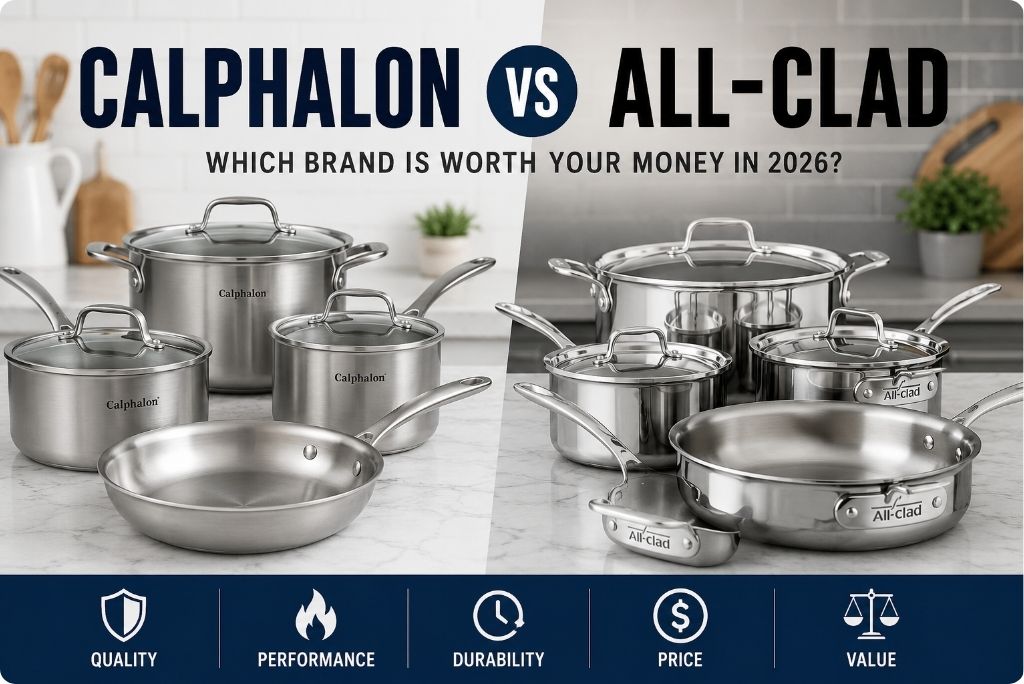
Calphalon vs All-Clad Cookware: Which Brand Is Worth Your Money in 2026?
If you are comparing Calphalon vs All-Clad cookware, you are probably trying to answer one very practical question: which brand gives you the best cooking performance for your budget and the way you actually cook? That is the right question to ask, because both brands are well known, but they are not built for exactly the same buyer. Calphalon focuses heavily on value, versatility, and approachable performance, while All-Clad positions itself as a premium bonded-cookware brand with a long reputation for professional-grade results.
This guide breaks the comparison down in a clear, honest way. You will see where Calphalon is the smarter buy, where All-Clad earns its higher price, and which brand makes the most sense for your kitchen, your cooking style, and your long-term plans.
Quick Answer
Choose Calphalon if you want solid stainless steel cookware with good everyday performance, easier entry pricing, and a strong value-for-money argument. Calphalon’s stainless steel line uses an aluminum core for even heating, offers dishwasher-safe options, and its Premier stainless steel line is marketed as PFAS-free and non-toxic.
Choose All-Clad if you want cookware that leans more professional, with fully bonded construction, high oven and broiler limits, and the kind of long-term durability that many serious cooks look for. All-Clad’s D3 and D5 stainless collections are induction compatible, oven- and broiler-safe up to 600°F, and backed by a limited lifetime warranty.
If you want the short version: Calphalon is usually the better value, and All-Clad is usually the better premium investment.
Comparison Table: Calphalon vs All-Clad Cookware at a Glance
| Category | Calphalon | All-Clad |
| Core positioning | Value-minded premium cookware for home cooks | Premium bonded cookware with a pro-cook reputation |
| Stainless steel line | Stainless steel with aluminum-core options; Premier line highlights Turbo Temp and 3-ply/5-layer construction depending on piece | D3 tri-ply and D5 5-ply bonded stainless steel |
| Oven safety | Calphalon stainless steel is generally listed up to 450°F; some stainless pages highlight up to 500°F depending on collection | D3 and D5 stainless lines are oven and broiler safe up to 600°F |
| Induction compatibility | Many stainless steel pieces are compatible with induction | D3 and D5 stainless lines are compatible with any stovetop, including induction |
| Warranty | Calphalon stainless steel cookware is listed with a 10-year warranty; some premium collections carry limited lifetime coverage | Limited lifetime warranty |
| Price positioning | Lower to mid-premium, with individual pieces and sets priced more accessibly | Higher-priced premium cookware, especially D3 and D5 sets |
| Best for | Everyday cooks, value buyers, first-time stainless steel shoppers | Frequent cooks, serious home chefs, long-term buyers |
The exact model matters, because both brands sell multiple collections with different construction and price points. Calphalon and All-Clad each have entry-level and premium lines, so it is always smarter to compare the specific set or pan you plan to buy, not just the brand name.
Understanding the Brands
Calphalon Overview
Calphalon is a major cookware brand that offers stainless steel, hard-anodized nonstick, ceramic, and other kitchen products for home cooks. On its own site, Calphalon describes its stainless steel cookware as durable, elegant, and designed for precision cooking, while also highlighting Turbo Temp™ technology and aluminum-core construction for faster, more even heating.

One of Calphalon’s biggest strengths is range. It gives shoppers several ways to buy: basic stainless steel, premium Premier stainless steel, hard-anodized nonstick, and space-saving designs. That makes it easier to match a pan to a budget and a cooking style without jumping straight to the highest price tier.
Popular Calphalon Collections
Calphalon’s stainless steel lineup includes a more affordable stainless steel line and the premium Premier Stainless Steel line. The Premier pages describe durable multi-layer construction with a heat-responsive aluminum core and Turbo Temp technology, while the stainless steel category page emphasizes fast, even heat and available 3-ply or 5-ply Premier cookware.
For most buyers, the appeal is simple: Calphalon gives you strong everyday performance without forcing you into top-tier pricing. Its official product pages also show entry pieces at accessible price points, which helps explain why it is often seen as the better value choice.
All-Clad Overview
All-Clad is built around bonded stainless steel cookware and has long marketed itself as a U.S. cookware brand focused on performance and durability. Its official site says the company has been crafting bonded stainless steel cookware since 1971, and it states that its cookware is made in the USA with global components.

All-Clad’s reputation is tied to its bonded construction. The brand emphasizes fully bonded cookware, which is one of the reasons its pans are so often recommended for serious home cooks and professionals who want consistent heat and a pan that feels built for the long haul.
Popular All-Clad Collections
All-Clad’s stainless steel collection includes D3 and D5, two of its most recognized lines. D3 is tri-ply bonded stainless steel, while D5 uses patented five-ply construction. Both are induction compatible and rated oven and broiler safe up to 600°F.
If you are comparing All-Clad collections, D3 is usually the classic “buy once, use for years” option, while D5 adds more layers and a slightly different cooking feel. Either way, you are looking at cookware designed for high performance and long-term use.
Build Quality and Materials
Stainless Steel Quality
Both brands use stainless steel cooking surfaces because stainless steel is durable, easy to maintain, and widely used in food-contact products. The FDA states that cookware is a food contact substance, which means materials that touch food are regulated as part of the broader food-contact safety framework.
In plain English, stainless steel is popular because it does not react the way some other metals can, and it gives you a stable cooking surface for everyday meals. That is one reason both Calphalon and All-Clad use it heavily in their premium lines.
Construction Type
This is where the brands begin to separate.
Calphalon’s stainless steel cookware uses aluminum-core construction to improve heat distribution, and its Premier line is marketed with multi-layer construction. That gives it strong cooking performance, especially for home kitchens that want better heat control without paying luxury-brand prices.
All-Clad’s identity is built around bonded construction. The D3 line is tri-ply, while D5 uses five layers. More layers do not automatically make cookware magical, but they do help All-Clad deliver the stable, even heating pattern it is known for.
Thickness and Weight
In everyday use, All-Clad typically feels more substantial and more “professional” in the hand, while Calphalon often feels a little more approachable for people who do not want extremely heavy cookware. That difference matters if you cook often, lift pans with one hand, or move cookware in and out of the oven regularly. This is a practical judgment based on the brands’ bonded and multi-layer construction claims and the way those construction styles usually behave in the kitchen.
If you want lighter cookware that is still strong, Calphalon may feel easier to live with. If you want a pan that feels dense, stable, and built for serious heat work, All-Clad is likely the better fit.
Cooking Performance Comparison
Heat Distribution
Heat distribution is one of the biggest reasons people buy clad stainless steel in the first place. Calphalon says its aluminum-core and Turbo Temp technology are designed to deliver faster, more even heat, while All-Clad leans on its fully bonded tri-ply and five-ply construction for consistent cooking results.
In real cooking, that means both brands can do a very good job with sautéing, simmering, and browning. All-Clad usually has the edge when you want more precise, even heat across the full pan, while Calphalon gives many home cooks more than enough performance for daily meals. That is a difference in degree, not a difference between “good” and “bad.”
Heat Responsiveness
If you make sauces, reduce liquids, or cook food that changes quickly with heat, responsiveness matters. Calphalon’s Turbo Temp system is marketed for faster heat-up, while All-Clad’s bonded stainless steel is designed for controlled, even cooking.
For a busy weeknight kitchen, both brands respond well once preheated properly. For people who care a lot about tiny heat changes, All-Clad generally feels more refined, but Calphalon still performs well enough for most home cooks.
High-Heat Cooking
This is where All-Clad often pulls ahead. Its stainless steel lines are rated oven and broiler safe up to 600°F, which gives it more flexibility for searing, finishing in the oven, and higher-temperature techniques.
Calphalon stainless steel is also versatile, but its oven-safe limit is lower on many pages, with the stainless steel care page listing the pans at 450°F and the stainless steel product page noting up to 500°F for the line shown there. That is still strong for normal home cooking, but it is not as hot-handling as All-Clad’s top stainless collections.
Everyday Cooking Performance
For eggs, chicken, vegetables, pasta, soups, and simple sautéing, both brands can handle the job very well when used properly. Consumer Reports’ current cookware guidance says good-quality stainless pans heat quickly and evenly, which fits the basic strengths both brands are trying to deliver.
The real difference shows up in consistency. All-Clad usually gives a little more confidence when you want repeatable browning and even heating. Calphalon usually gives enough performance for the average home cook at a friendlier price.
Durability and Longevity
Durability is one of the most important reasons to buy premium cookware, because the whole point is to avoid replacing pans every few years. Both brands back their stainless steel lines with long warranties: Calphalon lists 10 years for stainless steel cookware, while some of its premium collections have limited lifetime coverage; All-Clad backs its cookware with a limited lifetime warranty.
All-Clad’s bonded stainless steel has the stronger reputation for long-term kitchen abuse, especially if you cook often, use high heat, and want a pan that stays stable for years. Calphalon can absolutely last a long time too, but its value proposition is more about excellent performance at a lower entry cost rather than the strongest possible premium build.
A useful way to think about it is this: if you want the longest possible ownership life and are willing to pay more upfront, All-Clad is easier to justify. If you want strong durability but care more about budget balance, Calphalon is often the smarter buy.
Safety Comparison
Is Calphalon Safe?
Calphalon’s stainless steel page says its stainless steel cookware is free from PFAS, PFOA, lead, and cadmium, and its use-and-care page notes that the cookware is dishwasher safe. That is reassuring for readers who want a straightforward stainless steel cooking surface without chemical-coated nonstick concerns.
The FDA also notes that cookware is part of the food-contact materials category, which is the right lens to use when thinking about safety. In practical terms, Calphalon’s stainless steel line is a conventional, food-contact-safe cookware choice for normal home use.
Is All-Clad Safe?
All-Clad’s stainless steel cookware uses bonded stainless steel and aluminum, and the brand’s care pages focus on proper use, washing, and oven limits rather than chemical coating concerns. Its stainless steel lines are designed as durable, food-contact cookware for everyday and high-heat cooking.
If you are comparing safety in the broad everyday sense, both brands are solid choices. The real safety questions usually come down to using cookware correctly, avoiding extreme overheating with any pan, and paying special attention to nonstick lines rather than stainless steel lines. The FDA has also warned recently about some imported cookware products that may leach lead, which is a reminder to buy from reputable brands and avoid questionable cookware sources.
Metal Leaching
People often worry about aluminum, nickel, or chromium when they hear “stainless steel.” In normal use, the main point is that the cooking surface is stainless steel, while the aluminum is used inside the pan for heat conduction rather than as the exposed cooking surface. That is why clad stainless steel is so common in premium cookware.
For most home cooks, the bigger issue is not metal leaching from reputable stainless steel cookware but using unknown, low-quality cookware from unverified sources. That is especially important given the FDA’s recent warnings about certain imported cookware products.
Oven Safety
All-Clad clearly wins on oven-temperature flexibility in the stainless steel lines discussed here. Its D3 and D5 stainless collections are rated up to 600°F, while Calphalon’s stainless steel lines are listed at 450°F on the care page and up to 500°F on the stainless steel product page shown in search results.
That difference matters if you roast often, finish dishes under a broiler, or want maximum flexibility from one pan. For regular home cooking, though, Calphalon’s oven range is still enough for many recipes.
Ease of Use
Weight Comparison
Cookware should feel sturdy, but it should also be manageable. All-Clad’s dense bonded construction gives it a premium, solid feel, while Calphalon often aims for a more approachable balance between strength and everyday handling. That can be a real advantage if you cook frequently but do not want pans that feel tiring to lift.
For people who have smaller hands, cook on a crowded stove, or move pans to the oven often, the less demanding feel of Calphalon can be a practical benefit. For cooks who prioritize stability and don’t mind extra heft, All-Clad feels more reassuring.
Handle Comfort
All-Clad markets oversized, double-riveted stainless handles on its D5 line, and Calphalon also emphasizes long handles that stay cool on the stovetop across several collections. In plain terms, both brands understand that the handle matters as much as the pan itself.
Handle comfort is partly personal preference. If possible, hold the pan before buying. The best cookware is not just the one that cooks well; it is the one you enjoy reaching for every day.
Pouring Performance
All-Clad’s D5 line highlights flared rims for cleaner, drip-reducing pouring. Calphalon’s stainless steel cookware also includes practical details such as pour spouts and straining covers on some pieces, which makes everyday cooking a little easier.
These are small details, but they matter. Better pouring design means fewer drips, less mess, and smoother day-to-day use.
Lid Design
Calphalon offers tempered glass lids on several stainless steel and Premier lines, while All-Clad’s stainless collections typically emphasize bonded cookware and matching lids with heat-safe limits listed in care guidance. Glass lids are helpful if you want to monitor simmering without lifting the lid, while metal lids usually feel more durable and work better for higher-heat use.
If visibility matters to you, Calphalon’s glass-lid options are convenient. If maximum oven flexibility matters more, All-Clad’s stainless focus has the edge.
Cleaning and Maintenance
Stainless steel is not “nonstick,” so both brands ask a little more effort than coated pans. Calphalon says its stainless steel cookware is dishwasher safe but still recommends handwashing to preserve luster, and it advises allowing pans to cool before washing to avoid thermal shock.
All-Clad’s care guidance also emphasizes handwashing and proper use. That is a good reminder that premium cookware lasts longer when you treat it well, not when you assume it can be abused just because it is expensive.
A simple maintenance routine works best:
- Preheat before adding food.
- Use enough oil or butter.
- Let the pan cool before washing.
- Use nonabrasive sponges for routine cleaning.
- Remove stuck-on food with a gentle soak instead of harsh scrubbing.
Compatibility With Different Cooktops
Both brands cover the major cooktop types well, but All-Clad’s stainless steel collections are especially explicit about induction compatibility and high-temperature flexibility. Calphalon also lists induction compatibility on many stainless steel products and care pages, though exact compatibility can vary by collection.
Here is the simple version:
- Gas: Both work well.
- Electric: Both work well.
- Glass/ceramic: Both work well.
- Induction: Both offer compatible stainless steel options, but always check the exact model.
If you have an induction, make the exact model check a habit. That one step prevents most buying mistakes.
Product Line Comparison
The most useful comparison is not “brand vs brand” in the abstract, but collection vs collection.
- Calphalon Premier Stainless Steel is the premium Calphalon stainless option, marketed with Turbo Temp technology and aluminum-core performance.
- All-Clad D3 Stainless is the classic tri-ply bonded line and one of the brand’s best-known stainless collections.
- All-Clad D5 Stainless adds five-ply construction and keeps the same high oven and induction flexibility.
A practical way to look at it is this: Calphalon Premier Stainless Steel competes more with All-Clad’s entry stainless lines on value, while All-Clad D5 is the more premium, more expensive step up.
Price Comparison
Price is one of the clearest differences between the two brands. Calphalon’s stainless steel pieces on its own site include items like a 10-inch fry pan at $49.99 and an 8-piece Premier Stainless Steel set at $599.99. By contrast, All-Clad’s official D3 and D3 Everyday stainless set pages show much higher set pricing, with examples in the $699.99 to $1,149.99 range depending on the exact collection and promotion.
That does not automatically mean All-Clad is overpriced. It means the two brands are aimed at different buyers. Calphalon is trying to give you premium-feeling cooking performance at a more accessible price, while All-Clad is asking you to pay more for its bonded construction, heritage, and long-term performance reputation.
If you care about value per dollar, Calphalon usually looks better at the checkout. If you care about maximum long-term performance and are willing to invest more upfront, All-Clad usually justifies itself better over time.
Related Topic: HexClad vs All-Clad
Warranty and Customer Support
Warranty support is one of those details many shoppers ignore until something goes wrong. Calphalon lists a 10-year warranty for its stainless steel cookware, while several of its premium collections carry limited lifetime coverage. All-Clad backs its cookware with a limited lifetime warranty.
That difference matters because warranty length often reflects how a brand sees its own cookware: Calphalon gives solid coverage, while All-Clad leans into the idea of a lifetime kitchen investment.
Pros and Cons
Both brands are good, but they serve different kinds of cooks. Calphalon is usually the easier buy for everyday home use, while All-Clad is the stronger choice if you want premium performance and do not mind paying more.
Calphalon Pros
- Good value for the price
- Easier to buy without a huge budget
- Works well for daily cooking
- Comfortable for many home cooks
- Stainless steel options are safe and practical
- Good choice if you want solid performance without overspending
Calphalon Cons
- Not as premium-feeling as All-Clad
- Usually has lower oven-safe limits
- May not heat quite as evenly in every situation
- Less ideal for cooks who want the best possible long-term investment
All-Clad Pros
- Excellent heat control and even cooking
- Very strong build quality
- Better for high-heat cooking and oven use
- Feels sturdy and long-lasting
- Great for serious cooks who use their pans often
- Strong reputation for durability
All-Clad Cons
- Much more expensive
- Can feel heavy for some users
- The price may be more than many home cooks need
- Not always the best value if you cook only occasionally
Real-World Cooking Scenarios
Scenario 1: Busy family cooking every night
Calphalon is often the better fit here. It gives you strong all-around performance, simpler pricing, and enough durability for regular weekday use without overspending.
Scenario 2: Weekend home chef who loves searing and sauce work
All-Clad makes more sense if you care about precise heat control, high-heat searing, and using the same pan for stovetop-to-oven cooking.
Scenario 3: First-time stainless steel buyer
Calphalon is usually the friendlier entry point. The price is easier to justify, and the learning curve of stainless steel feels less intimidating when the cookware itself is not ultra-expensive.
Scenario 4: Serious long-term cookware buyer
All-Clad is the better long-term bet if you want to buy once and keep cooking for years. Its warranty, construction, and premium reputation all support that idea.
Scenario 5: Induction cooktop owner
Both brands can work well, but you must check the exact model. All-Clad is very explicit about induction compatibility in its stainless collections, and Calphalon lists induction compatibility on many of its stainless steel pages.
Which Brand Is Better for Different Buyers?
Here is the simplest buying guide:
- Best for beginners: Calphalon
- Best for value: Calphalon
- Best for frequent cooks: All-Clad
- Best for high-heat cooking: All-Clad
- Best for long-term investment: All-Clad
- Best for everyday family meals: Calphalon
- Best for premium kitchen feel: All-Clad
- Best if budget matters most: Calphalon
This is not because one brand is “good” and the other is “bad.” It is because they solve slightly different problems for different cooks.
Common Mistakes When Choosing Between Calphalon and All-Clad
A lot of buyers make the same mistakes when comparing premium cookware.
The biggest one is choosing only by price. A cheaper set is not always a better deal, and an expensive set is not always worth the jump unless you will use the extra performance. Another mistake is comparing an entry-level collection from one brand to a premium collection from the other and assuming that represents the whole brand. That creates a misleading comparison.
It is also easy to overlook oven limits, induction support, and warranty terms. Those details matter more than marketing language, especially if you cook often. Finally, many buyers purchase oversized sets they will never fully use. A smaller, better-chosen set is often a smarter investment than a giant box of pans.
Related Topic: HexClad vs Le Creuset Cookware
Frequently Asked Questions
Is All-Clad really worth the extra money?
For frequent cooks who value top-tier heat control, durability, and high-temperature flexibility, yes, All-Clad can absolutely be worth it. For casual cooks, Calphalon often delivers enough performance at a better price.
Is Calphalon cookware good?
Yes. Calphalon’s stainless steel and Premier stainless steel collections are built for everyday home cooking, and the brand clearly positions them around fast, even heating and practical durability.
Which lasts longer?
All-Clad generally has the stronger long-term reputation because of its bonded construction and lifetime warranty support, but both brands can last a long time if used and cared for properly.
Which heats more evenly?
Both brands are designed for even heating, but All-Clad’s bonded tri-ply and five-ply construction gives it the stronger reputation for consistent heat across the pan. Calphalon also uses aluminum-core and Turbo Temp technology to improve even heating.
Can both go in the dishwasher?
Calphalon says its stainless steel cookware is dishwasher safe, though it recommends handwashing to preserve luster. All-Clad’s care guidance emphasizes handwashing.
Which is better for induction?
Both brands offer induction-compatible stainless steel options, but you should always check the exact collection and product listing before buying.
Which brand do professional cooks prefer?
All-Clad is more closely associated with professional-grade bonded cookware and has a stronger pro-kitchen reputation overall. Calphalon is more commonly seen as a strong value-focused home-cook brand.
Final Verdict
If you want the best balance of performance, ease of use, and price, Calphalon is usually the smarter buy. Its stainless steel cookware gives home cooks strong everyday results, useful features, and a more manageable price point, especially in the Premier stainless line.
If you want a cookware set that feels more like a lifetime investment, All-Clad is the stronger premium choice. Its bonded tri-ply and five-ply stainless steel lines, high oven-safe ratings, induction compatibility, and lifetime warranty make it a standout for serious cooks who use their pans often and do not mind paying more upfront.
The honest conclusion is this: Calphalon is the better value, and All-Clad is the better premium performer. The right choice depends on how often you cook, what kind of meals you make, and how much you want to spend today versus over the next ten or twenty years.