David Burke Stainless Steel Cookware Review: Is It Worth Buying?
If you’re searching for David Burke stainless steel cookware review, you’re probably trying to answer a simple question: Is this cookware actually worth buying, or are you better off spending your money on another brand?
That question is harder to answer than it may seem because David Burke sells more than one type of cookware. Its current cookware lineup includes stainless steel, hybrid nonstick, and ceramic-based collections, so the exact product or set matters when comparing materials, construction, and performance.
For its stainless steel line, the brand currently describes its cookware as commercial-weight, heavy-gauge stainless steel with a tri-ply aluminum core. The company’s website also says its cookware is designed for induction and other common cooktops and is oven-safe up to 500°F. These are useful specifications, but they are manufacturer claims, so they should be considered alongside the actual construction, cooking experience, care requirements, and price of the specific piece you’re considering.
The most important thing to understand is that stainless steel cookware is not automatically good simply because it is stainless steel. The quality of the construction, thickness of the base, heat distribution, handle design, and price all matter.
So in this review, we’ll look beyond the marketing language and focus on what really matters to a home cook: how the cookware is built, how it should perform, how easy it is to live with, and whether the value makes sense compared with other stainless steel options.
David Burke Stainless Steel Cookware at a Glance
| Category | Assessment |
| Brand | David Burke |
| Cookware Type | Stainless steel cookware |
| Construction | Manufacturer describes tri-ply construction with an aluminum core |
| Stainless Steel Grade | Not clearly specified on the current main product information reviewed |
| Core | Aluminum core according to the manufacturer |
| Cooktop Compatibility | Manufacturer states compatibility with all major cooktop types |
| Induction Compatible | Yes, according to the manufacturer |
| Oven Safe | Up to 500°F according to the manufacturer |
| Dishwasher Safe | Check the instructions for the specific piece |
| Best For | Home cooks wanting stainless steel with a heavier, professional-style build |
| Main Consideration | Exact construction and specifications can vary by product line, so check the individual model |
| Overall Value | Potentially strong when purchased at the right price, but compare construction and warranty before buying |
The most important point in this table is the word “specific.” David Burke cookware should not be treated as one single product with identical specifications across every collection.
The current official website describes its stainless steel cookware as heavy-gauge, commercial-weight cookware with a tri-ply aluminum core. A tri-ply design generally means a conductive aluminum layer is combined with stainless steel layers to improve heat distribution while retaining the durability and easy-care qualities associated with stainless steel.
However, shoppers should still check the exact product listing before purchasing. Retailer listings and older product lines may not always contain the same information as the brand’s current website.
Who Makes David Burke Cookware?
The David Burke collection page says Chef David Burke partnered with Frieling USA to create “The David Burke Collection,” and it describes the items as professional grade and battle tested in his restaurant kitchens. The same page also points readers to Chef’s Kiss At Home for more of the products. In other words, this is a chef-branded collection with retail distribution, not a standalone direct-to-consumer cookware house built around a single flagship product.
That matters because brand structure affects how a review should be read. Chef-branded cookware can be good, but it can also vary a lot by line, retailer, and product tier. The safest approach is to judge each piece by its actual construction and specifications rather than assuming every David Burke item performs the same way. That is especially important here because the catalog mixes different families like Regency and Splendor, and the construction notes are not identical across them.

Materials and Construction
The strongest sign of value in stainless steel cookware is not the shine. It is the structure underneath. In stainless cookware, the steel gives you durability and corrosion resistance, while the core or base layer does the heavy lifting for heat control. A good stainless pan should heat evenly, respond predictably when the burner changes, and avoid obvious hot or cold spots. Reputable cookware testing sources emphasize consistent heat conduction and layered construction, often with aluminum in the middle, as a key marker of quality.
The David Burke Regency fry pan listings are encouraging on this point. Chef’s Kiss At Home describes the Regency line as 18/10 mirror-polished stainless steel with an impact-bonded encapsulated aluminum base. That is a practical construction choice because aluminum helps spread heat more evenly than stainless steel alone. The same listing also highlights pour spouts and thumb-grip handles, which suggest the line is designed for everyday use rather than showroom appeal only.
The Splendor Dutch oven takes a slightly different approach. Its product description calls out a commercial-grade heavy-gauge stainless steel body, a thicker base for accelerated and even heating, riveted cast handles, and a mirror finish. That combination points to a sturdier, more classic stainless steel vessel that is meant for soups, stews, braises, and bigger-batch cooking where stability matters as much as speed.
The important takeaway is that David Burke cookware does not appear to be a one-note line. Some pieces lean toward lighter, more maneuverable everyday pans, while others emphasize heavy-gauge build and oven-friendly versatility. That is a good thing for shoppers, but it also means you should review the exact piece you plan to buy, not just the brand name on the front of the box.
David Burke Cookware Cooking Performance
The construction of cookware matters because it affects what happens when you actually start cooking.
Heat Distribution
David Burke says its tri-ply aluminum-core construction is designed to provide even heat distribution and reduce hot spots. That is exactly what you would want from a quality stainless steel pan.
In practical terms, even heat distribution can make a difference when:
- Browning meat
- Sautéing vegetables
- Reducing sauces
- Cooking foods that need consistent temperatures
However, even the best multi-layer cookware can perform poorly if it is used on a burner that is much smaller or much larger than the base.
For best results, match the burner size to the pan whenever possible. Start with moderate heat rather than immediately turning the burner to maximum.
Heat Responsiveness
The aluminum core should help the cookware heat more evenly than a basic, thin stainless steel pan.
But there is a difference between even heating and fast heating.
A heavy pan may take longer to heat initially, but once hot, it can hold that heat more steadily. This is useful for tasks such as searing meat.
The downside is that a heavy pan may also take longer to cool down after you lower the heat.
That means temperature control is partly about learning how the cookware behaves. With stainless steel, experienced cooks often preheat the pan gradually, add oil at the right time, and adjust the burner before the food becomes too hot.
Searing and Browning
Stainless steel is particularly well suited to browning and searing when used correctly.
For steak, chicken, pork, or vegetables, the basic process is simple:
- Preheat the pan over moderate heat.
- Add a suitable cooking oil.
- Add dry food rather than very wet food.
- Allow the food to develop a crust before trying to move it.
One of the biggest mistakes new stainless steel users make is trying to move food too early.
If a piece of meat sticks immediately, that doesn’t always mean the pan is bad. Food often releases more easily after a proper sear has formed.
This is one reason stainless steel has a learning curve compared with nonstick cookware.
Sautéing and Stir-Frying
For sautéing, the combination of stainless steel and an aluminum core can be useful because you get a durable cooking surface with improved heat distribution.
The main question is whether the individual pan’s weight and shape suit your cooking style.
A large, heavy skillet can be excellent for cooking several servings at once, but it may feel cumbersome when you’re trying to quickly toss vegetables.
For stir-frying, a traditional stainless steel skillet also isn’t the same as a high-heat wok. If stir-frying is a major part of your cooking, the shape of the pan may matter more than the brand name.
Simmering and Sauce-Making
Stainless steel cookware is a natural fit for soups, sauces, gravies, and reductions.
The stable cooking surface is useful for foods that need to be stirred or reduced over time, while the aluminum core should help maintain more consistent heat than a thin single-layer pan.
The key advantage here is control.
Once the pan is hot, lowering the burner should gradually reduce the cooking temperature. With a heavy pan, however, remember that the cookware itself retains heat, so you may need to reduce the burner earlier than you would with a lightweight pan.
Cooking Delicate Foods
This is where expectations matter.
Stainless steel is not naturally nonstick.
Eggs, fish, pancakes, and other delicate foods can stick if the pan is too cold, too hot, or not properly lubricated.
That does not make stainless steel a poor choice. It simply means you need to use the pan differently from a coated nonstick skillet.
If you frequently cook eggs or other delicate foods and want the easiest possible release, you may prefer to keep a dedicated nonstick pan alongside your stainless steel cookware.
For most other tasks, stainless steel can be remarkably versatile once you understand how to control temperature.
How Well Does David Burke Stainless Steel Cookware Handle Everyday Use?
Cooking performance is only part of the ownership experience. A pan can cook beautifully and still be frustrating if it is uncomfortable to use.
Weight and Balance
David Burke emphasizes commercial-weight and heavy-gauge construction in its current stainless steel line. That can give the cookware a substantial feel and help it remain stable on the stovetop.
But heavier cookware isn’t right for everyone.
If you regularly lift a full pot, pour sauces, or move cookware from the stove to the oven, the weight becomes an important factor.
Before buying a large set, think about how you actually cook. A person who mainly cooks one-pan meals may be happier with a few well-chosen pieces than with a large set of heavy cookware.
Handle Design
The official David Burke website highlights ergonomically designed handles and helper handles on larger pieces.
For everyday use, a good handle should provide:
- A secure grip
- Good balance
- Enough clearance from the cooking surface
- Comfortable control when the pan is full
However, stainless steel handles can become hot depending on their design, burner size, cooking time, and whether the pan is used in the oven.
The safest approach is not to assume that a stainless steel handle will always remain cool. Always check the manufacturer’s instructions and use appropriate protection when necessary.
Lid Design
A well-fitting lid can make a meaningful difference when simmering, steaming, and braising.
When assessing a David Burke set, look at:
- How tightly the lid fits
- Whether steam can escape
- How comfortable the lid handle is
- Whether the lid can safely go into the oven
- Whether replacement lids are available
These details are easy to overlook when shopping, but they become important after months of regular use.
Is David Burke Cookware Easy to Clean?
Stainless steel is durable, but it is not magic. Food residue can still stick, especially when the pan is overheated or the user skips preheating and fat. That said, stainless steel is generally easy to maintain if you treat it properly. Reputable cookware guidance recommends letting the pan cool, washing with dish soap and a sponge, and using baking soda or a specialized cleaner for tougher stains when needed. Hand washing is also the safer choice if you want to keep the finish looking its best over time.
For David Burke cookware, the cleaning story should be viewed the same way. The mirror-polished stainless steel and heavy-gauge bodies should be durable, but they can still show heat marks or discoloration after repeated high-heat use. That is normal for stainless steel and does not automatically mean the cookware is failing. The real question is whether the pan still cooks evenly and cleans up without much effort, and that will depend partly on the piece and partly on how it is used.
Is David Burke Cookware Oven-Safe?
At least some pieces in the line are clearly oven-safe. The Splendor Dutch oven listing says it is oven safe to 500°F, while the glass lids are rated to 350°F. That is a useful feature for cooks who like to start on the stovetop and finish in the oven, or for recipes like braised meats and baked sauces.
The practical lesson here is simple: always check the exact model. Oven-safe ratings often differ by lid type, handle material, and product family. A cookware line can include both high-heat oven pieces and more limited glass-lid pieces, so the safest approach is to verify the exact listing before assuming all David Burke cookware shares the same temperature limit.
Is David Burke Cookware Compatible With Induction Cooktops?
The product pages we reviewed clearly confirm heat-distribution features and stainless steel construction, but they do not consistently spell out induction compatibility for every item. That means this is one of the first things a buyer should verify before purchase. Stainless steel cookware is often induction-compatible when the base is magnetic, but not every stainless steel pan qualifies automatically.
So the honest answer is this: some David Burke pieces may work on induction, but you should not assume it for the whole line without checking the specific model listing. This is exactly the kind of detail that can turn a review into a useful buying guide, because it helps people avoid a purchase mistake.
David Burke Stainless Steel Cookware Durability
Durability is one of the better reasons to consider stainless steel in the first place. Stainless steel is valued because it resists rust and corrosion, and heavier cookware with riveted handles and reinforced bases usually lasts longer under normal home use. The David Burke listings emphasize heavy-gauge bodies, encapsulated aluminum bases, and riveted handles, all of which are encouraging signs for everyday longevity.
That said, durability is not just about materials. It also depends on use. Repeated thermal shock, sudden temperature changes, and rough care can shorten the life of any metal pan. Good cookware guidance recommends letting pans cool before washing them so the metal is not stressed by sudden temperature change. For stainless steel, the best long-term care is usually steady use, sensible heat, and gentle cleaning.
David Burke Stainless Steel Cookware Pros and Cons
Pros
- The current stainless steel line is marketed with heavy-gauge, commercial-weight construction.
- The manufacturer describes a tri-ply aluminum-core design intended to improve heat distribution.
- Stainless steel provides a durable cooking surface without relying on a traditional nonstick coating.
- The current line is marketed as induction-ready and compatible with multiple cooktop types.
- The stated 500°F oven rating adds useful stovetop-to-oven versatility.
- Stainless steel can remain useful for many years when properly maintained.
Cons
- The stainless steel grade is not clearly stated on the main current product information reviewed.
- Heavy construction can make some pieces uncomfortable to lift.
- Stainless steel requires more cooking technique than nonstick cookware.
- Food can stick if temperature and cooking technique are not controlled.
- Exact specifications may vary between products, so brand-level claims should not replace checking the individual model.
- The value depends heavily on the actual price you pay and how the cookware compares with competing stainless steel options available at the same price.
The biggest potential weakness is not necessarily the cookware itself. It’s the difficulty of making a universal judgment about the entire brand without looking at the exact product.
David Burke Cookware vs. Other Stainless Steel Cookware
David Burke vs. Budget Stainless Steel Cookware
The main question here is whether David Burke’s construction offers enough of an advantage to justify its price over basic stainless steel cookware.
If the David Burke model you’re considering genuinely uses a well-built multi-layer construction, it may offer better heat distribution and a more substantial cooking experience than thin, single-layer budget cookware.
However, price matters.
A $20 stainless steel saucepan and a $100 saucepan do not necessarily provide $80 worth of additional cooking performance for every home cook.
If you’re mostly boiling pasta, making soup, or heating sauces, the difference may be less important than it would be for someone who regularly sears meat or cooks temperature-sensitive dishes.
David Burke vs. Mid-Range Stainless Steel Cookware
This is probably the most useful comparison for most shoppers.
Mid-range cookware often gives you a balance between price and construction. At this level, compare:
- Whether the cookware is truly multi-layered
- How far the conductive core extends
- Weight
- Handle design
- Warranty
- Availability of replacement pieces
- Current sale price
Don’t assume the more expensive pan will automatically cook better.
Instead, ask whether the extra money buys something you will actually notice.
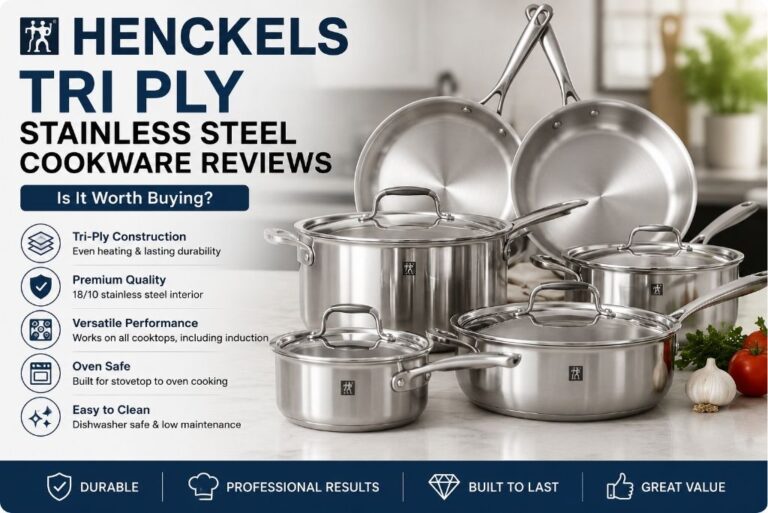
Read More: Henckels Tri Ply Stainless Steel Cookware Review
David Burke vs. Premium Stainless Steel Cookware
Premium cookware brands often justify higher prices through factors such as:
- More consistent construction
- Stronger warranties
- More detailed product documentation
- Better finishing
- Greater consistency across product lines
- Long-established manufacturing reputations
That doesn’t mean a premium pan will make your food taste dramatically better.
For many home cooks, a well-designed tri-ply stainless steel pan is already capable of excellent results.
The real advantage of moving into premium cookware is often refinement, consistency, fit and finish, and long-term ownership confidence rather than a completely different level of cooking ability.
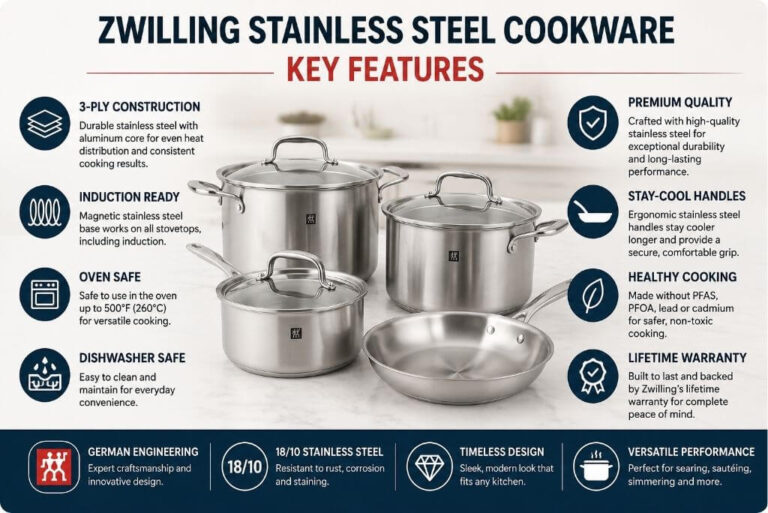
Read More: Zwilling Stainless Steel Cookware Review
Is David Burke Stainless Steel Cookware Worth the Money?
For many home cooks, the answer may be yes, but only if the piece matches the job. The David Burke line looks best when viewed as accessible stainless steel cookware with some thoughtful features rather than as elite professional gear. The brand story, the varied product lineup, the heavy-gauge build notes, and the practical design details all point toward cookware that can make sense for everyday kitchens.
The strongest argument for buying it is value. If the exact model you are considering has the right construction, the right oven rating, and the right cooktop compatibility, it may offer a good mix of performance and price. The strongest argument against buying it is uncertainty: some specs are clear, but not every retailer page gives the same level of detail, so buyers need to verify the exact listing before committing.
Who Should Buy David Burke Stainless Steel Cookware?
This cookware makes the most sense for home cooks who want stainless steel, prefer a practical price point, and value useful everyday features like aluminum bases, riveted handles, and oven-friendly pieces. It also seems well suited to buyers who cook regular stovetop meals and want cookware that feels sturdier than basic entry-level pans.
It may be less ideal for people who want a fully clad luxury set, need every spec spelled out clearly before buying, or rely heavily on induction and want guaranteed compatibility without checking the model first. That is not a criticism of the brand so much as a reminder that different shoppers have different needs.
What to Check Before Buying David Burke Cookware
Before purchasing, don’t rely only on the David Burke name. Check the exact product.
Here is the checklist I recommend:
- Confirm the exact model or set. Don’t assume every David Burke pan has identical construction.
- Check the stainless steel grade. If the grade isn’t listed, don’t assume it.
- Verify the construction. Determine whether the product is fully clad or uses a base-only design.
- Confirm induction compatibility. This is especially important if you have an induction cooktop.
- Check the oven rating. Confirm the temperature limit for both the cookware and lid.
- Review dishwasher instructions. Manufacturer guidance may differ between products.
- Check the pieces included in a set. A large piece count doesn’t always mean better value.
- Compare the current price. Look at what similarly constructed cookware costs from competing brands.
- Review the warranty. Understand what is covered and for how long.
- Check the return policy. This is particularly important when buying cookware online.
This is perhaps the most useful advice for shopping for David Burke cookware: buy the specific pan, not just the brand name.
Final Verdict
David Burke stainless steel cookware looks like a solid mid-market option for shoppers who want practical stainless steel with sensible design features. The line has real signs of thoughtfulness, especially in the Regency pans’ aluminum bases and the Splendor pieces’ heavier bodies and oven-safe construction. The official brand story also supports the idea that this is meant to be serious home cookware, not decorative kitchenware.
It is probably not the right choice for someone chasing premium fully clad performance at any price. But for a home cook who wants usable, durable stainless steel at a more approachable cost, it appears to be a reasonable contender. The safest final verdict is this: David Burke cookware is worth considering if the exact model’s specs match your cooking needs and the price fits your budget.
Frequently Asked Questions
Is David Burke stainless steel cookware good?
It appears to be a respectable mid-range option, especially where the listing confirms 18/10 stainless steel, aluminum-base heat support, and riveted handles. The best answer depends on the exact model you are buying.
Is David Burke cookware oven-safe?
Some pieces are. For example, the Splendor Dutch oven is listed as oven safe to 500°F, with glass lids rated to 350°F. Always check the exact product page.
Is David Burke cookware induction-compatible?
Do not assume it across the whole line. Check the exact model listing because the reviewed pages do not consistently state induction compatibility.
Does stainless steel cookware stick?
It can if it is used incorrectly. Good results usually come from proper preheating, enough fat, patience, and correct heat control.
How do you clean stainless steel cookware?
Let it cool, wash with dish soap and a sponge, and use baking soda or a suitable cleaner for stubborn residue if needed. Hand washing helps preserve the finish.